anime analysis etiketine sahip kayıtlar gösteriliyor. Tüm kayıtları göster

6 Ocak 2019 Pazar

Kill la Kill and Asexuality

Asexuality is not always necessarily a lack of sexual activity and feelings but rather a different perspective how one processes and experiences them. Despite the amount of nominally sexual content, the way the content is handled may allow Kill la Kill to be viewed as asexual, for the most part. The primary goal of this article is to challenge the belief that all sexual content are/should be viewed sexual by all those who experience it.
This article will contain mild spoilers about Kill la Kill and will discuss sexuality and nudity and sexual abuse, but it WILL NOT describe any sexual content in detail.
kill la kill everyone

(source)

First, what is sexual content? To give a definitive answer to this question would defeat the point of this article. Not only it depends on the person's culture and outlook, it almost always involve great double standards. But for the purposes of this article, anything might be sexual content if it is depiction of sex and genitals, including heavy euphemisms, nudity above midriff, underwear or anything with that function that only covers panty area. This description is good enough for us because it covers what general audience thinks when they say sexual content in Kill la Kill. However, it leaves us with a need of a criteria about when something becomes sexual, and for this article we will use following assumption:
No part of story, event, phenomena, situation or depiction is inherently sexual.
This will be called asexual gaze, where lack-of-sexuality is the default. No one needs to agree with this view completely, in fact asking that would be quite unreasonable as sexual socialization is something learned early and only can be unlearned slowly and probably to a limited extent. This article is mostly interested in informing the reader that, such a perspective indeed exists.  Also note that asexual gaze isn't purely developed for analysis, it is something I have realised in myself while discovering my asexuality.
Asexual gaze does not ignore the greater context which a particular depiction is surrounded by. In fact, this will be the metric we will use, sexual-coding. Sexual-coding is when a depiction is handled in a way underlying cultural context definitely points to sexuality. This is independent whether writers intend something to be viewed as sexual or not. It is also independent from audience reaction, whether a particular scene gets the viewer aroused or not is not very relevant. Sexual coding is not also a 0/1 switch, some depictions can be more heavily or lightly sexual than others.
A good example here is depiction of Quiet in Metal Gear Solid 5. Her partial nudity became so famous by to Hideo Kojima's infamous defense  that this depiction makes sense by the lore of the character. The thing is accepting the lore about Quiet does not affect her sexual coding. The very model-like shape of her body, the contrast between the design of her attire and the setting she is in, the realistic graphics, all the lighting, water effects and camera shots utilized all communicate something with the viewer on a cultural level. Whether the audience finds Quiet titillating or not is not important. The developers might not have intended any sexual depiction for real, but that does not matter either. This is how coding works, no work can be isolated from the culture that created it. The elements that creates the depiction of Quiet can be overlooked on their own, but together they end up making her scenes very sexual, much more sexual than most scenes in Kill la Kill.
rain 1

(just imagine bucket is Quiet)

Then, how should we analyze KLK? The show contains a large amount of scenes with nudity and uses its part of narrative; the usage of clothing as a stand in for fascism, for heterenormativity, for patriarchal expectations of women.. However, it would be also naive to claim that the show doesn't want the viewer indulge in nudity; at the end of the day it is a show aimed at teenagers. On the other hand, Kill la Kill was a show that definitely contributed to my realization that I am on asexual spectrum. For me, this anything else highlights there is something definitely more to this show.
In mid-2000s, a certain art/animation style has gained popularity among anime. Very smooth looking visuals with bright colors, realistic proportions, facial animations aiming for a certain level of realism, objects are rarely distorted etc... It is what often people mean by "anime look"., which is very different from KLK's visuals.  Chaotic and trippy animations, where things rarely stay in the same place, colors change widely, bodies change so much one can't be even sure of the actual height of characters. Most of the time it is not really pleasant, it gets almost sketchy where the drawn lines are deliberately made visible, objects generally have a very angular look but when things look round it gives the vibe of animation that is aimed at small children.
This visual style really lessens the sexual coding in the show. There is a reason why smooth-style is so popular, it makes producing "good-looking" anime rather easy, seasonal anime can hit at a certain aesthetic standard without much animation, a standard that is excellent for providing attractive anime girls to horny boys, with all the nice breast, legs, panty shots. For all its in-your-face sexuality, Kill la Kill avoids this for the most part. While yes, the transformations allow the audience enjoy the visuals somewhat, as I have said before this is not relevant to possibility of asexual gaze, they are mostly cartoonish and crude as most of the show itself. When characters have realistic bodies, they are either not depicted in revealing clothing or the scene is constructed as unsettling, like Satsuki being in captivity.  (Contrast Ryuko in Senketsu vs Ryuko in casual clothing) Those who are not convinced of difference the visuals make can research the fan art about Kill la Kill, it makes the lack of sexual coding in the show quite clear.
satsuki power
(source)
That's not saying Kill la Kill is completely without sexual coding. And what there is often feels bad and cheap. There is the abuse of Satsuki by Ragyou, which is used as a quick and cheap way to establish Ragyou's alien and monstrous character, although the the show is geniunely sympathetic to Satsuki here and they don't go into much detail, the show still would be better without it. The other moments of major sexual tension are Ragyou and Rui forcing Jinketsu on Ryuko, which is both genious and although for a good end, really uncomfortable and a hypnotized Ryuko kissing Rui, also unsettling but it is mostly euphemism and they really emphasise the clothing symbolism, so I am giving it a pass. There is also Mankanshoku family, especially Barazou, peeping on Ryuko which is problematic and completely unneccessary, once again with the crude visuals the viewer isn't made to participate in it, so it is less annoying then it could be. And the fact that Ryuko is cannonically a teenager makes these worse, but once again if you conceptualize her as older, actually nothing changes in show, it exist because the silent "A shounen anime must contain a high school or teenagers rule". However, while they lower the quality of the show somewhat with their presense, the fact that they are unnecessary means it can be ignored without really taking away from the show none of this really breaks the asexual gaze overall.
There is a particular scene that solidifies the asexual gaze is the scene of Episode 24 before credits roll, where the whole cast finds themselves as a pile of nude bodies. It is hard to find a depiction which desexualizes nudity to this degree in all fiction. It absorbs all taboo, tension, intimacy, excitement, passion, awkwardness, creepiness and mystery from nudity; leaving nothing but a cold pile of meat, just as if one is looking at an anatomy book or a statue. It is so meaningful that the scene which symbolizes the triumph of nudity over clothing is where nudity becomes completely asexual. The show agrees with the asexual gaze and even goes as far as claiming that allosexual views nudity is a flaw that gets in the way of freedom.
clapping

(Tracking the source of a GIF is very difficult, but it's from the show itself)

On the whole, I find Kill la Kill very asexual, at least much more asexual than most anime, or even most fiction that involves sexual imagery; precisely because it wrestles with such imagery and reaches to an asexual conclusion. The show as a whole is more asexual than a random cleavage zoom-shot in most fiction because of this. The latter is much more sexual,  it usually arises from context which is deliberately turned sexual, for audience participation. This is important because there is a nuance missing in calling nudity in KLK exploitative, which is probably even true to some extent. What makes nudity feel exploitative is that it being forcibly turned sexual in the first place. While the word is made meaningless and even used in bad faith, KLK is truly empowering to me  because it fights back against exactly that. Of course this is not an easy fight, the show itself falls back to being quite problematic at times, neither the attitude of producers, marketing, nor the commodification of sexuality helps. However, this is exactly one of the reason I love Kill la Kill so much. It truly rises above its creators, it points out to a future that we don't have to be surrounded by so much sexual coding in our daily lives, which is invaluable for people on asexual spectrum. It also tells that such a future can't be achieved without getting over our collective reluctance. There needs to be more meaningful discussions that does not end up calling all nudity in media bad, at the very least the whether cis men will masturbate something or not should not be the center issue.
This article is written thanks to my dearest Patrons and special thanks to: Alexandra Morgan, Laura Watson and Spencer Gill.


Madoka Magica, Importance of Self and Egoism

Puelle Magi Madoka Magica(PMMM) is a show with a rich philosophical subtext. Show's relation to Buddhism, Faust, Nietzsche etc. are all well discussed. However I don't think there is enough talk about how PMMM is connected to Egoism, despite being related to one of the central conflicts of the show.
First, let's talk about what Egoism is. It is a philosophy put out by Max Stirner. It asserts that a person's self-interest is paramount and all morality exists to erase the self in servitude to a higher being, an authority; be it God, the state, the family, the nation, the abstract idea of community or society. Any ideal, virtue, rule must be smashed so that self can be free. Egoism does not claim you shouldn't care about other people, it says your social relationships should be built on mutual self-interest rather than sacrificing one for the other and asserts that people help others because they are ultimately seeking their interest. (Love, recognition, ease of mind or the happiness and satisfaction of the act of helping). Also note that, self interest here refers someone believing what's best for oneself and there aren't any objective metrics to determine it at any given moment, because that would also be obeying standards that is external to your unique self.
As you can see, Egoism is a philosophy that is huge implications on politics and ethics but the part that interests me right now is the last part, the assertion that people ultimately follow self-interest in free decisions even it is seemingly for other people's benefit. This is one of the central themes of PMMM, as the concept of Magical Girl contracts is built on conflict that arises on this principle, which is deeply explored in three character arcs: Sayaka, Kyoko and Madoka, the main character herself.
At this point, spoilers ahead. Reader discretion is advised.

sayaka magical girl 2

Sayaka Miki

In Episode 3, we get the setup of our conflict. Mami warns Sayaka that she should be aware of her intentions while making wishes for other people's sake. And we know Sayaka deeply cares about Kyousuke and would really like to see his hand healed. Thus the dark strings of fate starts to slowly ensnare Sayaka.
She becomes a Magical Girl, in exchange of healing Kyousuke's hand. She is a girl filled with sense of justice so she really tries to protect people but that isn't why she becomes a Magical Girl, she wants the gratitude and affection of Kyousuke, which she doesn't receive in the slightest. It is important here that Sayaka isn't lying about her commitment to justice but she uses it as an illusion to act like her desires don't exist. Even worse, she comes to believe that these desires are antithetical to her ideals. At first glance, they indeed seem malicious, such as wanting Kyousuke to forever be dependant on her and hating Hitomi for "stealing" his love to the point of almost regretting to save her at Episode 4
Of course none of these truly represent Sayaka's self. Sayaka wants to do what is right but at the same time wants recognition. Healing Kyousuke's hand is both right thing to do and also an act that deserves gratitude. There is nothing wrong with this, self-interest is a deeply human thing. As Sayaka dons a both literal and symbolic cape of justice and an illusion of selflessness, she plunges headlong into destruction of the self, which also happens literally by becoming a Witch, the very thing she stands against for.
kyoko magical girl 1

Kyoko Sakura

Kyoko is interesting because as a mirror-image of Sayaka, you would expect she can be a good counterpart to her. She gets punished for wishing for other people early in her life, so now she lives with a mentality of only looking after herself. So, she lives according to the theme right?
Well, her Hobbesian attitude and self-centeredness is more of a defensive mask against the harshness of the world. One could say, with the conditions at hand, this behavior seeks self-interest and thus, true to Egoism but we learn that that's not the full extent of her character, she has a caring side she tries to repress. This is why, she doesn't actually live true to her unique self and still gets hung up by imposed rules, the rules she internalized by bad experiences, therefore denies herself being thoughtful of other people as a result.
In Episode 9, she comes much closer to living true her unique self when she fights to bringing Sayaka back. Remember, self-interest does not necessarily refer to 'rational' acts. Kyoko likes happy endings, so she fights for them, even if she doesn't prevail in the end.

madoka bow 4

Madoka Kaname

If we have a character that tries to pursue selflessness and another one that only fakes being selfish, then what would main character be? Being truly selfish, of course. See, Madoka is great precisely because she stays true to her unique self consistently without necessarily being self-centered.
Madoka has a unique situation among Magical Girls that she does not have an immediate need or deep-seated desire for something in particular, she is a happy ordinary girl with a nice life. In a Drama CD, we learn that Madoka's wish in the first timeline is to save a cat from a tree (hence the cat from the opening), something that is really silly to waste a wish for but, well, it is something she does without any external restrictions regardless.
Of course, she is not free of dreams or desires. She thinks she is mediocre and is not much help to anyone. (Episode 3) This is why in the first timeline, she dies without regrets because being a Magical Girl and helping people in itself is a good prospect for her. Exactly what Sayaka wants to be but can not. Throughout the show, she struggles finds a good reason to become one after seeing how painful being a Magical Girl is and only comes close to when there is a life-threatning situation. All of her actions comes from her fears, her sadness, her sense of friendship, what she thinks right and wrong without necessarily following an abstract idea of justice. Exactly in the way Kyoko wants to be authentic. Homura's warning of "don't forget who you are" is both ironic and meaningful. Madoka always stays true to her unique self, just not in the way Homura thinks.
With Homura's help, after a very long and hard journey of preserving her 'self', Madoka finally enters a contract, so she can erase the concept of the Witch from the history, resulting in Madoka's ascension, becoming with everyone everywhere. This the most Egoist moment of PMMM, in more ways than one:
  • Eliminating the concept of Witch means the "destruction of self" is literally gone for Magical Girls.
  • She rejects the rule and authority of the current universe and asserts her unique self instead.
  • When she brings her friends back to life, Sayaka dies in a battle, but she doesn't forcefully keep her friend alive. She respects the freedom of people and trusts Sayaka to decide for herself. Madoka becomes the goddess of mutual self-interest.
  • Becoming a goddess exactly fulfills her wish. She thinks she is mediocre and she becomes the strongest among all Magical Girls. She wants to be useful and she ends up helping all Magical Girls who ever lived, and the world as a whole by preventing its doom.
  • Ironically in the act of erasing Madoka as a literal person and becoming selfless, she becomes the most selfish. Often, what we describe as selflessness is really just removing the contradictions between your desires and your thoughts.

Puelle Magi Stirner Magica

Can we say PMMM is Egoist? Probably not. Standing against authority and morality is very important part of Egoism and "the importance of the self" theme stays mostly at an individual level. Regardless of what you think of Egoism, denial of self-interest is actually a real problem. People might not turn into literal monsters because it, but they can become destructive in the pursuit of selflessness all the same. This is why, even I don't fully agree with it, Madoka Magica will always remind me of Egoism at a certain level.
This article is written thanks to my dearest Patrons and special thanks to: Alexandra Morgan, Laura Watson and Spencer Gill.


Three Faces of Homura

Sequels to media that already concluded itself plot or theme-wise stand in a weird place. Even when they are well produced, they can't really get rid of the feeling of being tacked-on most of the time, because they have to undo the closure of the original work or even retcon events and characters all together. But perhaps, a different approach can be taken. A good show/book etc. can be written so that the sequels can be experienced as alternative conclusions instead of erasing the original work's ending.
From this point forward there will be massive spoilers about Puelle Magi Madoka Magica (PMMM). Also, there will be abuse talk. Reader discretion is advised.
madoka goddess 7
When it comes to PMMM, the mainline stories are the original series and Rebellion, the canon sequel, at least in name. But there are blatant continuity errors between them, Rebellion being the sequel doesn't seem very correct. A big example is Sayaka here. How is she alive in Rebellion? At the end of PMMM, with no uncertain terms, Sayaka is dead. This is very important for her character arc and yet she is well kicking on Rebellion with no questions asked from anyone. Is this a part of the Witch illusion shenanigans too? Even then, it wouldn't make much sense, the whole Witch thing is bad in itself. There is also the whole Charlotte issue... That's why for me, Rebellion is not a story that continues on PMMM, at least not without ignoring certain parts of the show.
Why is this important? I am certainly not the one to think that continuity errors or even most inconsistencies make a work worthless on their own, to certain extend In fact, I find that way of critique unhealthy as it over-priotizes technical aspects of a work over its expressive value. Furthermore, Madoka Magica as a franchise is itself all about alternative timelines. This means PMMM and Rebellion don't have to be connected at all, we just need to look at Rebellion as not a direct sequel, but an alternative timeline where certain things happens so Sayaka is still alive after Madoka becomes God.
If we can look past the technicalities in writing and take Rebellion at a face value, we see it is thematically very different from the main show. One is about hope and other is about obsession. This difference shapes the characters differently and by the virtue of being the central character on most conflicts in both series, it affects Homura the most.
Here is my theory: Homura's character in PMMM and Rebellion is different and it is incorrect to assert that there is a single holistic interpretation of her character. That doesn't end there, Rebellion itself is open to interpretations as well. That's why, for me in main series, there are at least three different versions of Homura:
  1. Homura is evil. (Rebellion)
  2. Homura is sympathetic and tragic. (Rebellion)
  3. Homura is misguided but good-willed and on a path of healing. (PMMM only)
I will just present the first two without judgement and then try to make sense out of them when we come to the third one.
homura serious 2

1. Homura is evil.

PMMM isn't subtle about Homura's obsession of Madoka. Throughout the show, we see Homura hurting her in various ways. Intimidation, concealing information, stalking(observe how she always can be so on time to prevent Madoka from entering a contract with Kyubey), expects Madoka to be dependent on her, basically prevents her to act her on will. All of these behaviors can be considered abusive. In Rebellion Homura's obsession gets worse to the point of becoming a witch and usurping Madoka's powers. Despite knowing that being a god what Madoka ultimately wants, she takes complete control over the destiny of Madoka, creating a timeline where their roles at the beginning of the story are reversed. Madoka is now a transfer student, has no friends thus even more timid than usual and emotionally dependent on Homura. At this point, Homura doesn't even care what makes her happy, she just has a specific idea of "Love" which wants Madoka to be happy but only in ways Homura allows her to be. This is just creepy as any other abuse story, that's why this viewpoint holds that the character  progression in Rebellion is sensible for Homura and the ending is thematically appropriate.

homura glasses

2. Homura is sympathetic and tragic.

This viewpoint makes sense if you see Homura more on the heroic side in PMMM. For whatever she does, it ends up in a positive note (at least in the beginning) and she wants to save her friend's life, which is quite reasonable despite her extreme methods . And those extreme methods are painful but necessary because at the timeline of the main story, she already has run out of options. Homura isn't happy or satisfied in any of it. She keeps a cold face but deep inside, she is always the shy, clumsy girl who loves Madoka a lot.
But in the end, it's the love that ruins it all, because even it is apparent that it is good for the universe, Homura never gets what she truly wanted: to being with Madoka. After all she sacrifies, she can never accept an ending where she is separate from Madoka. The resentment gnaws her heart, until she gets the slightest clue that Madoka might not be happy as a god. A that point she finally snaps and becomes a witch.
The real divergent point from "Homura is evil" theory comes about here. Unlike all other witches, she returns to being a Magical Girl after becoming a witch. Thus, this viewpoint suggests that Homura's act of betrayal is out-of-character but this make sense in the plot because she get corrupted and warped by becoming a witch in the first place.
Alas, the maw of misery truly entraps Homura. We can see how her familiars treat to Homunculy, expressing her self-loathing. This becomes even worse after she becomes a demon, a form she deliberately assumes for herself so that she can be seen and reviled as evil. But despite how unbelievably edgy she acts, Homura doesn't do anything she does out of malice. After all, she puts the Incubators to their place and creates a world that is genuinely happy for her friends. But she also knows she is doing a great mistake, she knows she has cornered herself into situation she can't escape. She can't hold back Madoka, they will clash with each other which will likely result in Madoka's return to godhood. At the end of Rebellion, she just eerily smile herself and dances alone, it doesn't communicate any happiness at all. She messes up greatly, the worse part is there is nothing she could do to prevent this. From the moment she accepts being a Magical Girl, her fate is sealed, there is only going to be pain for her. She is never be able to be friend with Madoka as she was before. Homura's story is the story about heartfelt feelings of love, loyalty and determination becoming twisted into abuse, obsession and ruin.
homura bow

3. Homura is misguided but good-willed and on a path of healing.

It can be said that this viewpoint is a synthesis of previous two viewpoints. I feel like when people evaluate Homura's character, they tend to omit some complexities.
First, there is Homura's obsession of Madoka. It is clear that there is something definitely unhealthy about Homura. However, one of the chief mistakes done when analyzing her is failing to recognize the full-scope of what she is going through in PMMM.
Obviously, there is nothing wrong with wanting to save your friend. There isn't anything done against Madoka's wishes at that level, sure she says she is genuinely happy about being a Magical Girl and doesn't have any regrets, but that doesn't mean she is ok with dying, it's just a resolution that comes at the inevitability of death. But Homura's actions are not only about saving her friend, Homura clearly adores Madoka and feels indebted to her. Remember that Homura is a very timid and mediocre girl who has no friends at the beginning. Someone acting genuinely welcoming and friendly in that situation would certainly leave a big impression on you. (That's very relatable to me from personal experience.) Homura feels she couldn't give anything to her friends, only to watch them die one by one. So, when an opportunity of saving her friend comes along, obviously she would not say no to that! And when she fails each time, she could just do better next time right?
I don't think she is obsessed about Madoka at the expense of others. Being so determined in one path can narrow your vision but I can't find anything to really suggest that Homura doesn't care anyone besides Madoka. We have clearly shown that in all timelines, her attempts of communication fails. The group even becomes more hostile at her as the time goes: Mimi is emotionally unstable and Sayaka's fate cannot be changed. Homura clearly can't save them, she just has the ability to go back in timeline, not change the entire lives of people after all. Yet, I still don't think she is entirely cynical about them either. She rushes to save Sayaka's Soul Gem in Episode 6, without much thinking after all. I don't think it's a calculated move, just something that arises out of sympathy for a fellow Magical Girl.
homura smile
When we look at cold actions of Homura from this angle, she becomes a much more sympathetic and still flawed person. There is a reason why she is so cold to everyone to the point of being abusive. Going back and re-living all the misery 100 times surely takes a toll on your psyche and at this point in story, she doesn't have too many options. That doesn't excuse her bad actions of course, nor implies that she is without mistakes. She is still not the cold-calculating person she pretends to be, she gets shocked at Mami's death, is not proactive enough to prevent Sayaka from becoming a Magical Girl and does not anticipate Kyoko's death. Of course she could have done better, of course you could always do better in a given situation. But...
One of the things that annoys me most when people talk about fiction is the fairly pervasive belief that people always would do better than fictional characters in tough situations, this is usually accompanied by a general disdain of failure and incompetence of fictional characters, despite the fact that they are both very much s part of being human. It is easy to judge Homura for not being morally upright enough, but could you really act all that better in her situations? Some people aren't really aware how easy to do right choices when they aren't the ones living through them, it's easy to criticise a 14-year-old girl, who sess horror and despair worth of decades, for her bad treatment of her friends but how many of us could even function as a human being in a similar situation? For me, that alone in itself is worthy of praise. In this way, the show plays with Determinator trope from both sides, showing how unhealthy can it be while also being an act of valor. Is this not true for all great deeds as well? The most heroic acts clearly requires to throwing out rational thinking to some degree.
madoka homura hug 1
However, I am also hesitant to call Homura "heroic". Because in the grand scheme of things, she doesn't have much agency in the story. She clearly doesn't plan for Madoka becoming stronger, nor she is actually able to achieve any real progress on her own. On the contrary, in each timeline the fate of the characters becomes worse. I find it ironic that people criticise Madoka for being passive while not seeing how helpless Homura actually is. Madoka is able to defeat Walpurgisnacht on literally every timeline and Homura just fails harder each time. The show even directly tells us how entrapped she is at Episode 11:
-"Why does she go that far to fight?"
"It's because she still seeks hope. I imagine if it comes down to it, she'll nullify this timeline, like she has done in the past, and continue fighting. She'll continue to repeat this meaningless chain of events having come out none the wiser. Giving up and no longer moving forward holds the same meaning to her now. The moment she's convinced that there's no way for her to change your fate, that all of this was pointless, Akemi Homura will lose to her despair and change into a Grief Seed. She knows this for herself. That's why, to her, there is no choice. It doesn't matter if she even has a chance to win; she has no choice but to fight."
--"You're saying that she has no chance for salvation as long as she holds hope?"
~ Kyubey and Madoka.
In end, that exactly happens. Homura finally accepts the truth: She cannot save Madoka from becoming a Magical Girl, her own existence as a Magical Girl depends on Madoka becoming a Magical Girl. The effect cannot nullify the cause. So, no walking back this time, it's time to confront the ugly reality of all your efforts crumbling under your eyes, to embrace the cold, thorny arms of despair and to let your heart darken by grief...
But no, Madoka doesn't let this happen. For all Homura wants to help Madoka and wants to show she can look after herself, it is Madoka that ends up saving her from the abyss. Madoka creates a hopeful world, where all Magical Girls can find peace of heart, including Homura.
This is the primary reason I don't like Rebellion all that much. It lessens the impact of a character arc so that it can tell a story the main show already did. Love turning obsession was an already major theme in the show. Ironically, a rebellion already happens in PMMM, rebellion against the fate of Magical Girls, rebellion against the hell Homura created for herself. Rebellion is feels like returning the same fate.
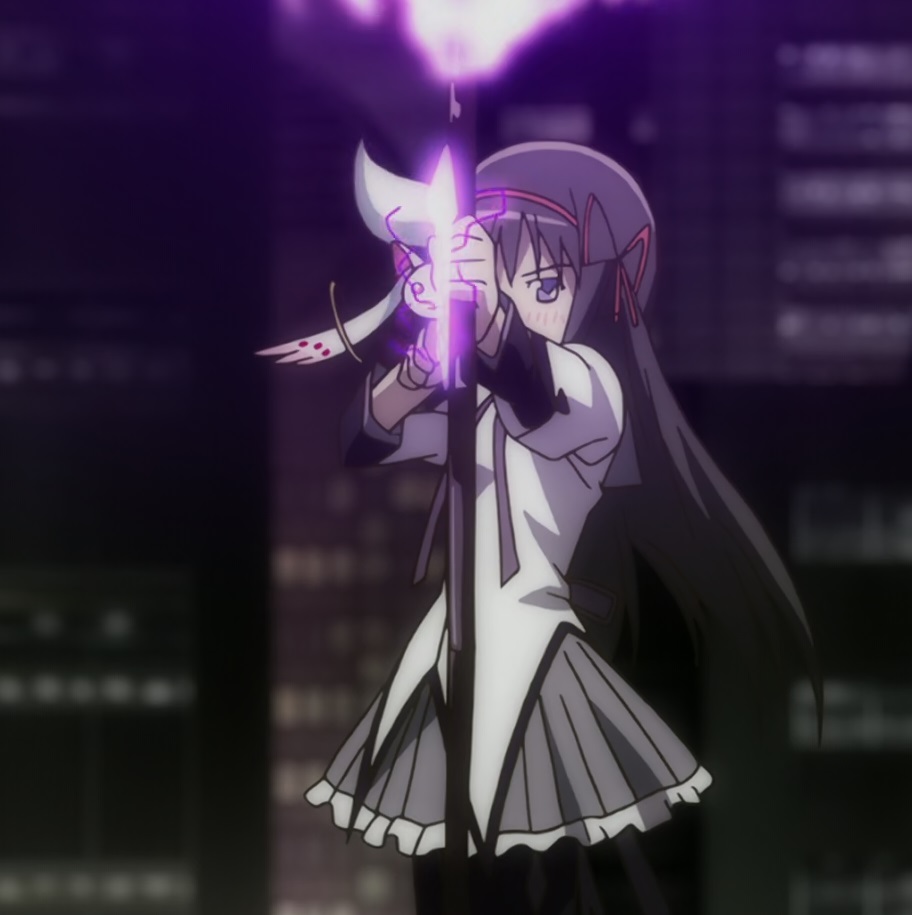
There is hope at the end of PMMM. A hope for Homura too, a path of healing, a chance for curing her obsession , making her love pure and healthy again. Of course it won't be easy, people don't get cured from a single day and perhaps after all she goes through, a full healing is not possible. But in her lowest moment, Homura already accepts she can't save Madoka. For how I see it, she is aware this is the best for Madoka. Perhaps she won't be able to be a friend she wanted, but Madoka will be always with her, broken might she be, she won't be alone anymore. And what symbolises this better than giving up old weapons and fighting like Madoka does? For me, gun is the symbol of her obsession, her loneliness, her misery but bow is the symbol of hope, love and born of healthy emotions inside Homura.
madoka hope
Rebellion is not a bad movie. It's well made and thought-provoking. But it devalues the character developments in original and at best it reintroduces the themes the main show was better at conveying. And personally, I prefer a timeline where there is hope for Homura, not only it just feels better after seeing all the pain, but a complex character like her deserves more than just being a piece of tragedy or a victim of turning into a miserable monster.
This article is written thanks to my dearest Patrons and special thanks to: Alexandra Morgan, Laura Watson and Spencer Gill.