
1. Campaign
The game and series in general is very good but this expansion was made in at the end of the great prosperity era of RTS games, and it shows. It is not a glorious, sprawling campaign similar to those in expansion packs of Starcraft and C&C games. It's length of a single campaign of a single faction, but in terms of content, it made me remember said grand campaigns in a lot of ways.The progression of the story fits the campaign really well. You start by building a country for yourself, then you get the loyalty of more soldiers, slowly advance your conquest, fall back and defend yourself, put plans in motion, destroy your enemy bit by bit, then achieve full destruction. It's quite different from the large battles of the regular campaign. And narrative-wise, it's pretty satisfying, there is much less dialogue compared to works like Warcraft 3, but it has a similar feeling of grandeur. You take a part in destruction of a proud kingdom and control cool looking people and monsters while doing it, and that's pretty satisfying as far as an RTS story goes.
Levels themselves are quite varied from one another, most of them actually fit for the game's micro-heavy[1] nature even better. There is a one level where it is better to avoid fighting enemies, one you have to defend your ground in small areas, one large map where you can destroy one city, block by block, wall by wall .Developers made a good job of introducing the new faction, having a decent level of difficulty and learning curve. And there is even an epilogue where you play as the Good side. Within the budget they have --you can see with cutscenes being entirely drawings -- they did as well as a job they could.
Of course, a campaign mode is only a small part of an RTS experience. What the expansion pack brought to the table in terms of gameplay changes is perhaps even more exciting. The base game is so important for its brilliance in combining LoTR flavor, easy to get in gameplay and a nice tactical depth, but it had some rough edges after playing a lot. The expansion smoothens these rough edges and plays into te base game's strengths even more. This is the reason I have left analyzing the gameplay here, as someone who researched quite a few mods -- this is probably as good as a Middle-Earth RTS game can get.

2. War of the Rings
While BFME 1 campaign style had its problems, it had its own charm. So it was actually not quite gone in the sequel, just turned into somewhat different. Instead of a scripted sequence, now it's a risk-style game between teams of Good and Evil. There are different scenarios that changes map sizes, team sizes, available countries and victory conditions, but the basic idea is the same. Build, create units, defeat enemies on the regular RTS map and conquer provinces from your enemies.It fixes the main problem of the first game's campaign: the levels just don't get reduced to walking the entire map and destroying every single building, they are short encounters .There is a maximum unit size, money given to you is usually just enough for things you need. AI actively surrenders in battle or withdraws from encounters it knows it can't win. This is actually strategically sound as well, because if you drag the battle when you are at losing side, you are just giving enemy more time to build units and snowball into stronger armies. Although you get stronger with each province you control, comebacks are very much possible.
Overall, I don't think it's an unforgettable part of the game, but it is much better than I have expected and it's a very nice distraction if you don't just want to do skirmishes all the time.

3. Create a Hero
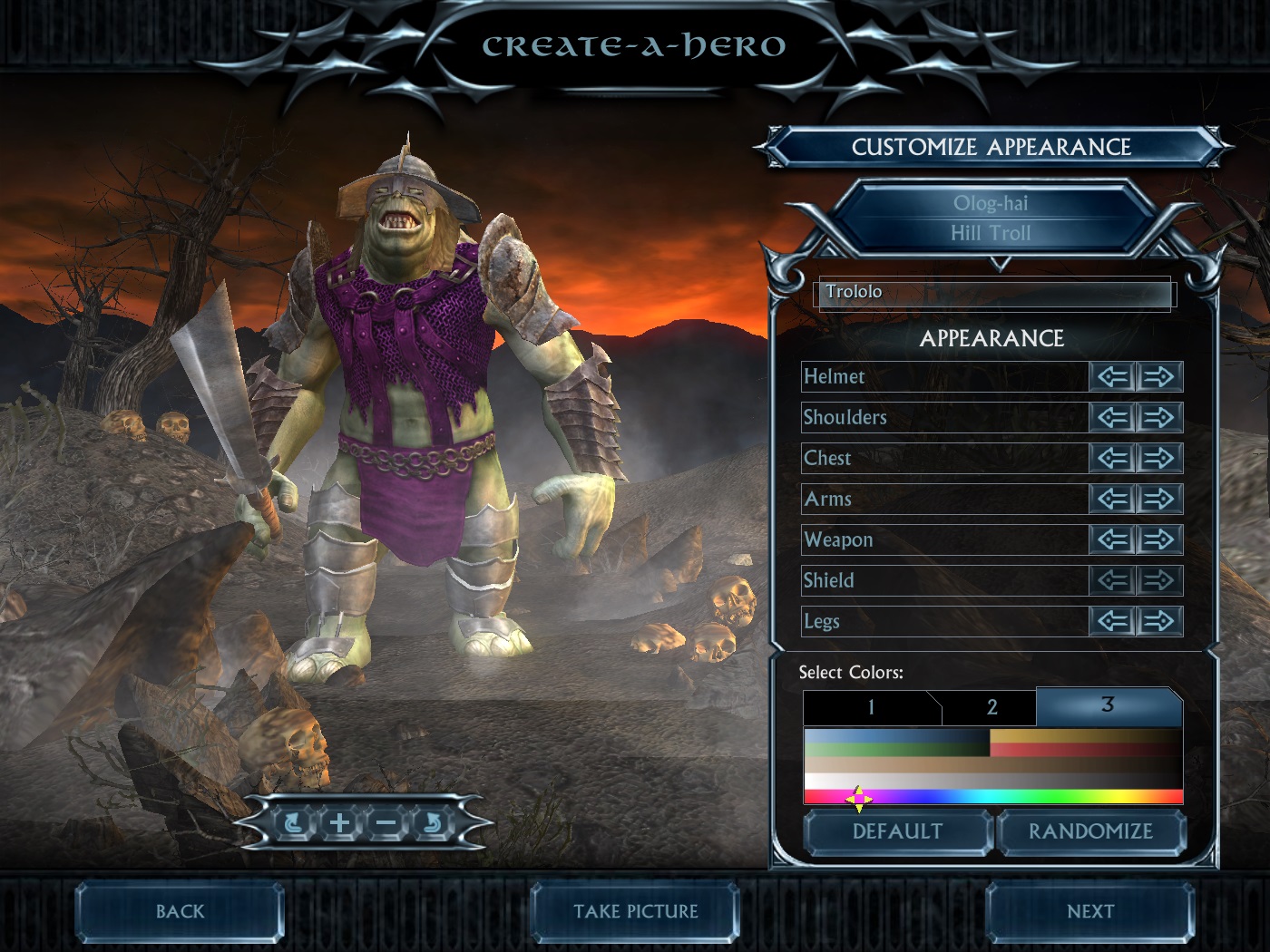
This game mod is one of the things that give BFME 2 a unique place among RTS games. It easily adds at least a dozen of hours to play time by itself. You can make the most overpowered, the most silliest heroes, or try to cover a certain faction's weakness. It also helps appearance and that the skills of custom heroes are sufficiently different from normal ones, so having custom heroes actually adds stuff: Like you can have a Haradrim hero that converts enemy units into your cause or a wizard that turns people into cows.The expansion adds the two balance changes. Now you are free to not pick powers for the heroes as much as you like (as opposed to having to select something for each level) and now the price of the hero scales up with the powers. So, a hero with an array of really powerful skill is more than 3000 gold like a true late game hero, but you can also make a basic hero for 1200 gold that only is useful for specific tasks. That means the best heroes are the ones that are as strong as possible while being cost-effective. These changes bring a tactical depth that was not in the main game. It also fixes the main game's problem of custom heroes being more overpowered on the Good side, because you have a really good mid-tier Evil hero that is just as useful.
4. The Battlefield
BFME 1, for all its faults, had a strong foundation for a gameplay with a distinct identity. The sequel built on its strengths while fixing things that held it back. No fixed building slots, a tighter resource game, higher command limits, a much more balanced metagame. And... what will that end up us with?A harmonious blend of post Red Alert 2 Command&Conquer games and Warcraft 3, spiced heavily with Middle Earth sauce. We saw this in BFME 1: Power of the One Ring a.k.a. field magic/bonuses that are unlocked by destroying enemy units, units interacting each other with actual physics (such as units getting scattered around when rocks fell over them), unit modes that are toggled on/off manually, units leveling up, automatic resource/army collecting points, feel quite C&C, heroes, caves for experience and gold, easy economy, a micro-focused command, naval units feel quite like Warcraft 3. Of course, the lack of ranged air units, most units being composed of one or two dozens of individuals, constant eternal resource generation, manual upgrades for each unit are the most unique to BFME 2.
Identity: is a thing I am frequently returning throughout this article, because I think it is a bit underrated in understanding what puts an RTS game above their peers. Balance, technical quality, tactical depth are all really important. However, you can still have so many space marine strategy games, so many DOTA clones, so many Age of Empire type games people can faithfully play at a time. Middle Earth background obviously helps but it has a risk of making the game predominantly feel a LOTR game before anything else. BFME 1 handled this by departing from RTS conventions significantly, BFME 2 on the other hand does this in little details, even playing for a several minutes, the game's identity oozes from every pixel. Let's discuss some of these details in particular:
Combat
Unlike a lot of RTS games, there is a heavy amount of close combat. And, as I have mentioned, units fight in blocks( blocks made larger in sequel), these two affect how fights occur. If you order several battalions of units to destroy an enemy unit&building, you will see only a couple of soldiers are actually fighting at the same time. If you want them to fight efficiently, you have to flank and circle enemy units. Games like Starcraft encourage blobs or death balls, just a group of supporting units you can point somewhere and cause havoc. No, if you leave your units to their own, you will find them wither away in no time.This gives ranged units extra special because they can actually concentrate their full power easily and of course can attack from afar and inside the towers. This makes them a prime way to fight against enemy heroes. To balance these advantages, they don't hit too hard aganist buildings and they are especially weak aganist cavalry charges, unlike the first game. Also arrow upgrades are usually can be obtained only at highest level of building, and elite ranged units can't upgrade their armor.
Airborne units are uncommon, either found as heroes or temporarily summoned, their attacks are slow but strong and have an area of effect, which you can somewhat control for more efficiency. Their main advantage is traversing great ranges at a short time and having a great field of vision. Which makes them prime for harassing enemy units and resource or guarding an area but bad at attacking tankish heroes or anything involving strong ranged units. Thankfully, their super passivity from the first game is fixed in the sequel, which made them really borderline worthless.

Cavalry -- not just horsemen, any unit with crushing forward effect -- are very good for their mobility, their quick disposal of enemy units and high damage, but even mediocre ones are expensive, costs more command points and hard countered by pikemen. Of course, close attention is required to make their charges effective, as collisions with melee units also affect them a little bit. There is also cavalry archers, combining the power of mobility and range, but balanced with either low armor or not being able to upgrade armor.
Spearmen, prime defensive units, are always reliable. Generally cheap, a quick remedy for monsters and cavalry, good at pinning down heroes, good at holding a line, but kinda slow at damage. In contrast, non-spearmen melee infantry -- is jack-of-all-trades of units. They have either offensive charge or defensive shield wall, have good damage and get upgrades early but they don't have the utility of spearmen or tactical depth of archers, and tend to be food for heroes and monsters
Siege units, units specialized for destroying buildings are three groups: Melee machines, ranged machines and monsters. Melee machines like rams can destroy a building really quickly but obviously need to get close. Ranged machines have slow but steady projectiles from a very good range, but need a minimum distance to fire. All siege machines are very vulnerable against non close attacks.. Monsters are on the other hand, can usually both attack melee and from range with great damage but weak aganist spearmen and heavy archer fire. Siege units hold great place in BFME 2, while they are not crucial in most battles, they play a huge role in punishing turtling strategies, such as archer tower/wall spam.
Heroes, which can defeat any non-hero unit 1-on-1, are the cornerstone of the game. And in sequel, every faction has plenty of good heroes. The amount of heroes is not sequel, but that's fine, because they cost command points now. Realistically, you will see probably a maximum of three or four heroes from a faction at the same time, and that would be during a rather long game. This is where the game diverges from Warcraft 3, it's not expected to just slap a hero into your army, there are situations where a couple of battalions would be more useful than a level 1 hero. Another difference from Warcraft 3 is the heroes, even the ones who share tactical roles, feel unique thanks to the lore, the greater diversity in skills, and appearance, as opposed to generic heroes who get a randomized name.

One of the most unique aspects of the game is its loose use of rock-paper-scissor style counter mechanics. For example, it's theoretically true that:
spears > monster > non-spear infantry > spearsBut non-spearmen units does not mop the floor with spearmen as spears kill monsters. Monsters will often have a ranged attack and can run faster than infantry. BFME 2 does not have a great range of unit types, so the game relies more heavily on contextual weaknesses which can be mitigated by clever play over hard counters. So, keeping pricing in mind, a more general consistent rule for non-heroes seem to be:
The harder a unit can hit and the faster it can move, the larger its weakness getsThis somewhat works for heroes too; a cavalry form of a hero will be weak against spears, heroes that can inflict immense damage tend to be on the fragile side.
Battle stances, standardized versions of various commands in BFME 1, control idle unit behavior. In aggressive stance, units will attack every enemy unit on their vision and will pursue them endlessly until they have doing so. In neutral stance, units will similarly engage units but will only pursue them for a certain distance, then will return to their original position. In defensive stance, the units will only engage when they are close enough for melee combat and will try to move as little as possible. They also get a slight increase and decrease in attack, defense and speed in stances. BFME 2 is a heavy on unit control so you are not supposed to leave them on their own, but units are fairly good at defending themselves. This level of automatic behavior actually eases the player into game's chaotic battles.
Upgrades for units need to be researched in its building first and have to be applied to each unit manually. The upgrades tend to cost a lot more than it does in most RTS games, but they also affect the unit more. They also visibly change the unit, I like that touch a lot.
The game does not have an elemental weaknesses system (which I think could work), but instead it has fire and poison as a prominent tool. Fire can be actively ignited on ground by certain units, causing area damage. Poison is applied to units individually and just causes health loss over time. It's generally not high enough to kill on its own but effective because it blocks over-time-healing.
Another way the game puts forward micromanagement over large economies is having lots of unit buffs and debuffs, almost to the degree of RPGs. With hero skills, ring powers, certain buildings, large amount of spells in the game is about temporary buffs. Warcraft 3 enforced small-scale combat by limiting the amount of units hard way. In this game you can theoretically have a really large army, but more often than not the skirmishes tend to be between small armies where larger buffs determine the outcome. Here we can see that a static counter system would be counterintuitive to such a design.
The Power of One Ring or The Power of Evenstar, as in first game, make everything more fun, but we get 25 over measly 10 in the first game. And there are more balanced this time all around. And they are effective, they can even change the fate of battle if cleverly used, which brings a real sense of dynamism to the game.
Lastly there is naval battles. The units are exactly the same for each faction functionally and built from open to all harbors. A transport ship that can't attack, a ship that attacks with arrows, a ship with ranged siege machine that can hit from far away, and a suicide ship that destroys a group of ships in contact. Naval battle is a nice thought, in Middle Earth lore sea is both important thematically and physically. Sadly, in execution we don't see really intense naval battles. I blame this on lack of good maps for emphasizing the naval combat. However, the ships themselves can be effective, especially considering they can be upgraded without any restrictions. The combat ship is a strong archer unit and bombardment ship is especially great since, it can really reach any place in the map. In fact, their command limit and price reflect their power, otherwise they could be somewhat game breaking, especially the bombardment ship.

Economy and Base
The game does not have permanent walls, eliminating all balance problems it brings. Instead most countries can build non-deployable walls, that can be modified with gates, towers or ranged machines. They cost a non-trivial amount of money, are not very durable. So, they don't enable over defensiveness but instead add a tool for controlling key points. Battle towers are much similar, can be deployed efficiently for defense, but not really game-breaking at all. Some maps come with pre-built fortress with heavy walls and defences but they are meant to be played against a group of opponents. There are also maps with pre-built towers that anyone can use, but they are even more fragile than player-built ones.For all factions, buildings can be built almost everywhere freely. This is not only a departure from a first game but a departure from most RTS games as they usually have some limitations on how to build a base. Building is a very simple process, as long as you have a builder and cash, you are free to go. Only resource buildings are subjected to some rules, the closer you build them to each other, the less money they will generate, and their command limit bonus will decrease. Flexibility of buildings brings another layer of tactical depth. You can actively place your buildings in a way to make the enemy fight more inefficiently, some secret buildings at the corners of map may change the fate of game, or you can retreat near your allies' base. As long as you have builders around, a comeback is possible.

One important building in particular is fortresses, the center of the base, to recruit builders, heroes, upgrade certain bonuses, to being able to use ring powers, and build some defenses to build your base. I am really pleased with the attention they have shown to fortresses, they really bring out the identity of a faction.
Resource buildings will generate money indefinitely -- except lumber mills -- as in first game, but having to build them at certain distances encourages aggressiveness. However, there is quite a few ways of getting more money; from skills, powers, outposts and so on. Making money in this game is not a very stressful affair, there isn't really optimal executions to get more resources so you can build the largest army possible. On top of that, resource buildings also control the command limit, which further simplifies macro management. And in most RTS games, you have at least two or three resources to control, but really in this game, it's effectively one. Command point exists more for discouraging spam and turtling rather than a real resource. This is one of the important design choices to make the game quite easy to get into.
That doesn't mean economy is trivial though. There are a lot of ways you can spend your money: Buildings, unit upgrades, castle upgrades, Unless you get absurdly strong in the map, your spending rate tend to be closer to the earning rate. It's not stressful but there is enough tension to encourage clever spending. Upgrading building or upgrading units or getting a hero, such decisions are the bulk of economical tactics and base building in the game.
You can set the starting money before battles. This is actually one of the things that forms a meta. 1000 gold starts are different from 2000 gold or 4000 gold starts. additionally, you can set handicaps which decreases a player's production if you are so inclined.
The Map and Gollum
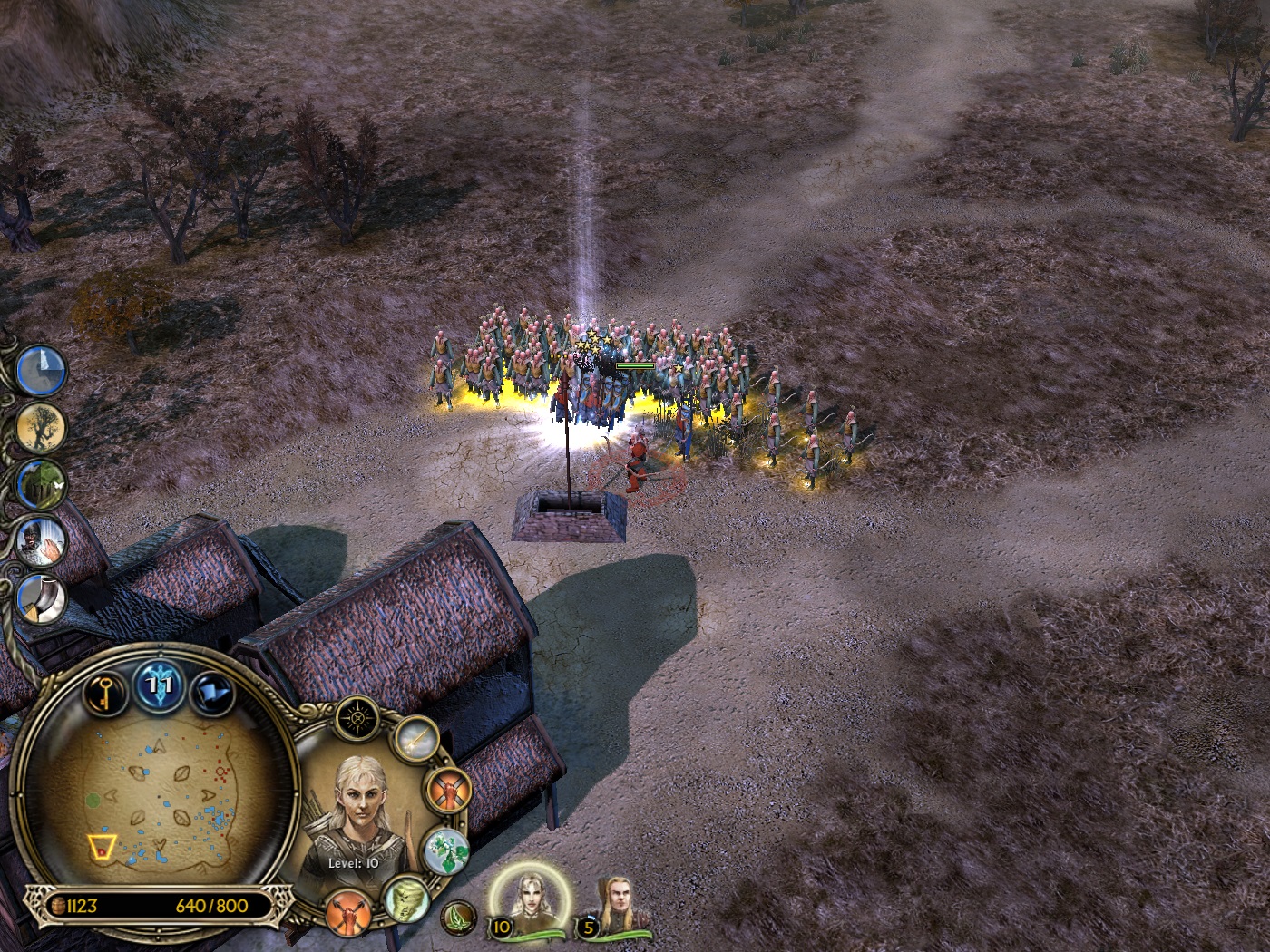
There are static buildings in the game maps, they are controlled by capturing its flag by a unit. These buildings are:- A signal fire tower --inspired by the tower Gondor used for calling help -- that gives vision and decreases power recharge times.
- An outpost to build units: The units change by the map and produces Hobbits, Dunedain Rangers, or Dale Archers for Good side, focusing on defense, and Dunland Warriors, Corsairs of Umbar, and Haradrim Archers for the Evil side, focusing on building destruction.
- An outpost for generating money. This outpost produces equal to the output of several resource buildings, so it is a great advantage to whomever it belongs to.
- And a dock for building naval units.
Caves are a feature that is expanded in sequels. Now there are six kinds of caves: Goblin, giant spider, warg, wight, trolls and drake cave, in the order of resource and experience gained upon defeating them. They will attack anyone nearby in a certain radius, including buildings, will rebuild and replenish unless completely destroyed. They function similarly to Warcraft 3's independent troll/ogre groups, as an experience farm and obstacle to capture outposts/build resource buildings. I have to say, outside of drake caves, I find them somewhat underwhelming. In Warcraft 3, these encounters are challenging as a major part of the game is about being able to level your heroe s and expand your base at an optimal pace. So, I understand why they wanted to keep it easy, it might have been too costly to try to defeat them. Still, instead of arbitrarily sprinkling them onto maps, one can design so that there are easy caves with measly loot near the player bases and tough caves with good loot towards the middle parts of the map or near resource outposts.
While the maps could certainly use more spice, but they aren't all that barren. Mountain ranges, bridges, rivers, forests, high ground... quite a few stuff affects movement, especially considering the near lack of air units. Also admirable is having more than a few asymmetrical maps or one side of map being mountainous while other side being open ground. As an example, imagine two players being close to each other while being apart from third player. Symmetrical maps are good for competitive balance but sometimes asymmetry brings a fresh air and unique challenges.
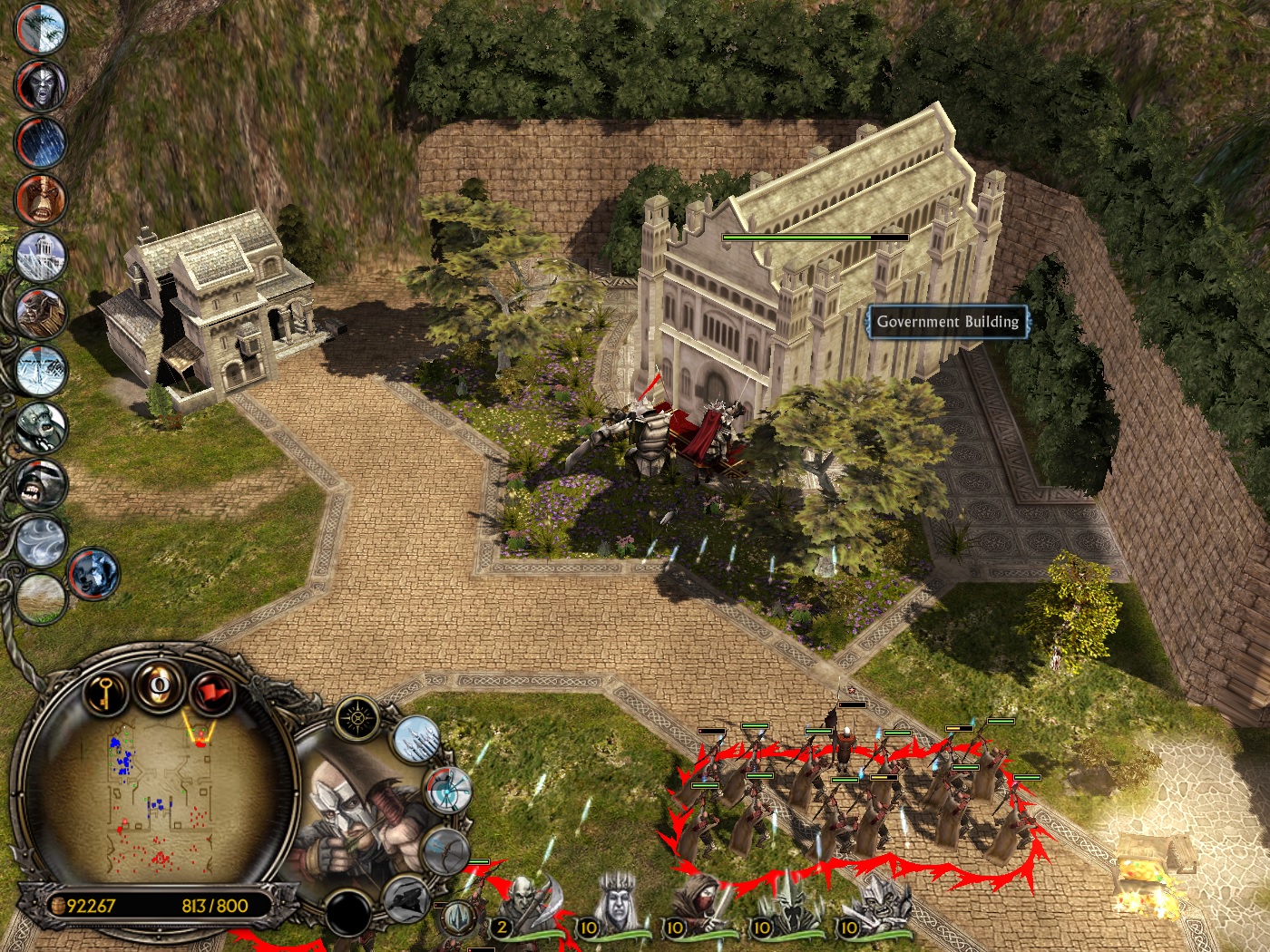
There are some very elaborate special maps that are also used as campaign maps, they serve as a set piece as they do as a skirmish map. These maps have one player behind castle walls and other player(s) on outside the open ground. The defender side has plenty of pre-built defenses and usually have a really good amount of resources but often has limited room for buildings, cannot build castles or use castle upgrades and start with a fixed amount of 2500 gold, so they can't spam their best heroes from start. In both single and multiplayer, I have plenty of memories with these maps. Minas Tirith, Minas Morgul, Helm's Deep, Fornost... But some of them are plain broken. Dol Guldur map for instance, does not have outposts for defending side and its interior really cramped so you can get barely any resources, makes them disadvantaged even against single player. In the opposite end of spectrum is Isangard map, as the attacker side is only one player for some reason.
Another thing on the map you can encounter is Gollum. He is usually on stealth but when detected can be killed quite easily, doing so drops the One Ring. Once on ground you can carry it with a unit and bring it to your fortress, then you can recruit Ring Heroes: Galadriel for the Good side, costs 10000 gold, can summon a large thunderstorm. And Sauron for the Evil side, cost 20000 gold, can summon a barrage of meteors to fall. Both of them are quite powerful, hit multiple targets with knocking effect as normal damage, can scare enemies and take quite a while to recruit, but Galadriel is more fragile and fast, while Sauron is bulkier and slower. If they end up dead, the Ring drops to the ground and becomes open to grab once again. It's always nice to see the Ring and Sauron in a LOTR game, and they are fun to use for curb-stombing the enemy, but as you can guess, they are not a serious part of competitive strategies, as their price makes them bragging rights more than anything else. It could be more dynamic, perhaps it could bring a small bonus to the owner faction, or be used as a way of make your Ring Powers stronger, or you could buff your hero for a smaller price, but to spice it up, there would be ways to steal the Ring from a fortress. As it stands in the game, it's a fun gimmick.
Of course, this is not all there is to it to maps, because as all good RTS games, BFME 2 has a map editor. I have merely glanced it as a curiosity, I can't comment on how easy to actually use it, but looking at user-created maps online, it's fairly flexible. You can have stuff like Balrogs fighting against Saurons, classic fan-favourites like tower maps or really creative works with serious design effort behind them. When games not only allow but internally support user-creations, only good can come from it.
3. Conclusion
Battle for Middle Earth 2: Rise of the Witch King is a spectacular RTS. It's easy to get into, open to mastery in fine details, smooth to play, alive and chaotic, but manageable. Certain aspects are not utilized for their full potential, but in minute-to-minute play, when re-imagining the lore of Middle-Earth, when creating orcs with purple armor the game is consistently full of energy. Just as I played the main game, I come back to this game every now and then, the time fleets as I lose myself in the song of arrows, spears, explosions and magic. If you could play only one real-time strategy game, try this one out, as the base game it is not officially sold anymore so it is effectively free. Unless you passionately hate anything related to LOTR, you'd probably have at least a decent time.Next time, we will look at the game even deeper and analyze the faction design of ROTWK!

All screenshots are mine.
This article is written thanks to my dearest Patrons and special thanks to: Acelin, Alexandra Morgan, Laura Watson, MasterofCubes, Makkovar, Otakundead and Spencer Gill.


