1 Aralık 2020 Salı

Game Difficulty

“Challenge” is not a inherent part of video games. Games can be toy-like, relaxing, simple, casual. Target demographic matters: It’s weird to complain that a game for children is child’s play. The hardware matters: It’s unfair to demand mouse-like precision when playing a console game. The design goals matter: Developers often rather have the players see end of a game. Challenge also cannot be separated from rest of the game design.: Some games are open-ended, focus on giving the player a lot of options. These games fundamentally rely on player agency, and have a hard time creating controlled environments for challenges, they are often more suited for self-imposed challenges. Nevertheless, a well-considered, tasteful level of difficulty can embolden core strengths of the gameplay, push the player out of their shell, and make them approach the game with a more sensitive eye that appreciates little nuances. It’s still good to have options however, because there is never a one-size-fits-all level of difficulty for everyone. There are also certain methods of difficulty that cause frustration more than not, and should best be left optional.

Medieval 2: Total War(2006) is dreadful to play on higher difficulties. All of your neighbors attack me on first opportunity, usually ignoring any other neighbors. When I try to play defensively and expand slowly, they will send armies over and over, there are times I have fought more than a dozen battles. It’s a most unwise way to play. The game isn’t unbeatable however, one just needs to play aggressively. The more aggressive, the better. The faster I conquer provinces, the more enemy becomes deprived from resources. I gain loot by capturing them and I get more taxes from new cities every turn, thus having even more armies to crush anything on my path. AI is completely helpless against this snowball effect. However, this isn’t too much fun either. This makes me too strong too early, and there is no time or need to use any sophisticated units. No guns, no heavy infantry, no elite archers. Just mercenaries, basic town units and general’s bodyguard can conquer the world. No need to any fun diversions like assassins, I can steamroll anyone before I can train one useful enough to kill a general. No need to care about religious mechanics or happiness in cities, I can just exterminate the population. No need to merchants, general traits, or most other mechanics. Even if I play recklessly and lose couple of cities, I can easily conquer more faster. The first time I did this, it was mildly enjoyable but the fact that I had to play like this every time made me soured any interest to play more in the future. Then, one day, I asked myself: “Why don’t I lower the difficulty?”. And I did. This made me finally remember why I liked the game so much once. I could play slow; develop large, bursting, happy cities and. build armies of elite soldiers. AI wasn’t obnoxiously aggressive and didn’t back-stab me in every chance. The game was pleasant, not stressful. I could play the way I wanted. I did not started any wars, merely retaliated, I released any prisoner I captured, never resorted the cruelty in conquered provinces. nurtured honorable and heroic generals. Diplomacy is bare bones in the game, but I still tried to keep my reputation as high as possible, because I could. I had so much fun when the game didn’t force me to optimize my behavior.

A common complaint about Elder Scrolls V: Skyrim(2011) is that the game is too easy, but such remarks hides the true grievances. There is a difficulty slider in the game, but the only thing it does is to punish the player for playing a magic-oriented build and make even the simplest encounter last 5 minutes. The game has difficult bosses, but the only real difference from easier ones is the amount of time they take to be defeated. As I have stated before, Skyrim is truly beautiful as a stroll in the forest. Whenever it tries to challenge however, it can only become a facsimile of better games. People don’t really complain that Skyrim is easy, they complain that it is a game that detests being hard. The fact that players and modders need to alter the gameplay so drastically to make the game even slightly challenging in the way most expect from similar games is a testament to the game’s inherent allergy towards difficulty.

In Trails of Cold Steel (began in 2013) series, the hardest difficulty "Nightmare" gives enemies more health and makes their attacks considerably more powerful. Protective abilities are costly and slow. Many bosses can heal themselves to full or make devastating attacks that pierce through any protective spell. If the characters are not fast enough, the enemies will get more turns and attack more. The only way to defeat the bosses is to be fast and strike hard as much as possible. Thankfully, the player can achieve really big combo attacks with correct builds. And, it works so well! The exhilarating rush of overwhelming the enemies with a well-planned chained of moves is superb, the game is able to create feeling of a flashy, bombastic arcade game within a turn-based combat system. Sure, it restricts the player options; as in one can’t approach the battles in the manner of classic RPG boss fights where the player slowly dwindles the enemy while trying to survive. This is perfectly fine, because the play style the game is pushing me is much more interesting. There are countless RPGs with “war of attrition” bosses. By punishing slow play, the game is able to guide the player into its unique and interesting features. And the beauty of difficulty options is such that, a player can always play on lower difficulties if it is too much for them. When it comes to linear gameplay, merely tweaking some numbers might be enough to make a game that’s just right for everyone.

A couple of difficulty modes can really enhance the game. I am bad at action games and when I saw Bioshock Infinite(2013)’s fast-paced, frantic gameplay, I knew I had to play the game on easy. And thankfully I did, it made the game quite tolerable overall, otherwise I cannot ever imagine tackling those sloppy gun-fights seriously. I like Starcraft(1998) quite a bit but, it’s Brood War expansion was way too brutal. There are no easy options, I am simply not good enough. And this is a inherent weakness of the games with unforgiving difficulty. A game won’t lose anything with having some cheats or a story mode. It will only win people who would otherwise give up on the game. Moreover, there is no reason to have the game resent the player for playing on easy. No locking main content behind harder difficulties, no fake endings, no mockery or passive-aggressiveness. Instead, it is much better to acknowledge and reward skillful play instead; with harder levels, enabling different ways of restrictions and so on. A game can’t and does not need to cater to everyone, but even a little seasoning can make it much more approachable to lots of people.

Beyond just different game modes, there are couple of noteworthy and, notorious patterns of difficulty I encounter in games:

Undoing huge amount of progress:

This is quite nasty. Old games did this a lot with limited lives, but the thing is, they were outdated even in Super Mario Brothers(1985). And that game was aware about this, it gave lots of extra lives and short-cuts so that players wouldn’t be too bothered by dying. I really like when games allow me to build to grow and be stronger, and don’t like when it demands me of re-take the challenges over and over to satisfy an arbitrary level of excellence. There is a case to be made about games with permanent death mechanic however. I am not too sure, because I have never played a game like that, but perhaps, because the game sets the player up for the end from the very beginning, it fosters a different kind of mentality than simply forcing them to making no mistakes. Otherwise, perfect runs can be offered as an optional mechanic.

Locking the ability to save:

I hate it, I really do. I should be able to save as much as I like, full stop. I don’t like checkpoints too, but I can tolerate them if they are numerous enough. This is the worst way to mess up with the player’s progress without openly trolling them. There is one fairly ubiquitous reason tampering with saves: To prevent “save-scumming”, in other words, loading old saves over and over to get a favorable outcome, as it usually bypasses the challenge to a certain degree. Here is my answer to this: Save-scumming is a response to faulty game design. It is usually not that fun. I would rather not do it, and I feel a lot of people wouldn’t too, but players don’t want to lose progress. Save-scumming happens either when something crucial is dependent on luck or the challenge is too demanding to take on at once. If the player is expected to embrace randomness, the feeling should be instilled very early on and the cost of failure shouldn’t be unbearable.

Europa Universalis 4(2013) is a game whose gameplay is heavily in the hands of fate. Battles, sieges and quite a few actions are influenced by dice, there are random events having positive or negative outcomes, there is at least a little randomness in almost every part of the game. Some of these random elements can be mitigated, a stronger country can weather more bad outcomes and, but even playing as a super-power, player is still sailing a boat on a raging ocean. And I get it, while it is frustrating sometimes, trying to recover from bad luck has its own charm. However, this completely turns on its head when trying to get difficult achievements. Now, not only I am only interested in optimal behavior, because of higher requirements or weaker starts I need to deal with, there is little room for failure. Obviously, for a “true challenge”, you are not allowed to load older saves during gameplay. Also obviously, I save-scum by quitting the game from desktop before it auto-saves. I am not going to risk hours of gameplay because of something random, ( or I misread the game’s not-ideal UI or it gave me wrong information or a glitch occurred or…) Randomness and perfection do not mix together.

Most games often do not have a graceful difficulty curve, there is usually that one place players fail again and again. And, it’s very understandable not to want to overtake a difficult challenge repeatedly just because of a single mistake. As I said before, demanding perfection can make players optimize themselves to boredom, and this is perhaps the most common way this happens. Again, having options help here. More tips, easier modes, cheats, perhaps allowing to skip levels are all better solutions than limiting saves. Besides the specifics of game design, the other solution is to avoid pushing players into perfection all together. Some games evaluate player’s performance at the end of the level. Missing a good score might be thing that pushes players into save-scumming. To prevent this, players shouldn’t feel like the game is screwed out of feeling complete. Giving player’s opportunities to recover from mistakes or dividing the challenge with checkpoints might convince players to keep going instead.

However tedious save-scumming might be, it’s always preferable to the anxiety of spending long stretches of time not being able to save. Some games try to be more experimental about save points, treating them as resources. for example. LISA: The Painful(2014) has one-time consumable save points, thankfully as an optional difficulty mode. Ori and the Blind Forest(2015) has limited saves, but the game is generous enough about them, and they actually serve to choose the re-spawn location. In most other cases, I don’t like deviations from convenience. This might seem narrow-minded, but I feel this is an issue beyond any issue in gameplay, it is a matter of fundamental user-friendly software design. Games are already time-consuming as they are, frankly they have no right to be so callous about player’s progress. There might be a troublesome glitch, a power outage, some sort of emergency, or player simply just wants to quit and continue later. I cannot ever see a justification of such entitlement to force players to play for an arbitrary about of time other than “People have adjusted themselves to a bad tradition.”. And as I said, I truly believe if save-scumming alone actually ruins the challenge of a game, that game’s design is truly flawed. Look at Trails in the Sky(2004), does it restrict saving and loading at all? No! Because, it’s a good game that is confident in it’s design.

Hiding Necessary Information

A boss turns out to be immune to the attack. The useless item from the beginning is maybe vital to get the best ending. Sometimes there is no map and there is no clue about what to do next. The intention is to give to player a sense of uncertainty and mystery. This can be used to great effect to make the player feel more adventurous, or heighten the sense of horror, but usually it just makes me to look up a guide. Game guides are fun, I love to learn about a game I enjoy as much as possible. and I even enjoy stumbling into secrets as much as anyone, but at the very least the game mechanics should be transparent as possible. Doing A yields B, getting X needs Y. I am not really sure what makes game devs so hesitant about this. Perhaps they are scared of their game looking too complex or maybe it’s assumed showing too many numbers break immersion in “cinematic experiences”? If the enemies in the game has level scaling for example, isn’t it much better to know that from the start? And surely it would be nice if player could make educated guesses about how their builds fare in the late game. Thankfully, at least as far as contemporary games are concerned, lack of information is never severe enough to stop players from soft-locking their game, but it’s still perplexing and occasionally frustrating that games are reluctant to explain themselves.

I love games which are honest about their challenges , rewards me for the progress I make and appreciate when they try to accommodate different levels of skill. I am also well aware that media is not produced tailor-made for me and respect games aiming for niche experiences, but I never look highly to games which are openly disregard user-convenience or accessibility to create challenges. Moreover, a game aiming for being difficult does not give it a blanket protection from criticism on it’s difficulty. One can desire a good challenge and can still find what’s offered overwhelming, tedious, or unfair. It’s always better to have an honest discussion on design instead of mocking people for playing badly. No one has to be good at the games and super majority of games are intended to be beaten, most anyone can beat a game if they put the work on it, but sometimes people just don’t feel it’s worth their time.

This article is written thanks to my dearest Patrons and special thanks to: Acelin, Laura Watson, , Makkovar, MasterofCubes, Morgan, Otakundead and Spencer Gill.

9 Eylül 2020 Çarşamba

Chapter 0: Introduction


Üyarimi!

Here, I will present a fictional constructed language named Limidu. I intend to convey its features in parts between articles. Since I have been working on it for a while, I have actually enough material to put out regular updates and remain ahead of the project. I am not very well when comes to linguistic terminology, and intend to present this language as a naturalistic one, so you shouldn't be intimidated if you are unfamiliar with conlanging. In any case, this video series is a great place if you want more info on conlanging itself. Also, I am just a hobbyist and do not have much experience, so if it feels sloppy I apologise in advance. Anyway, I hope you enjoy this presentation!

In this chapter, we will explore this langugae's background, sounds and will look at some example words and sentences:

Limidu

Limidu is the language of Moon Fairies. Moon Fairies are the group of clans of humanoid people with colorful, strong wings spanning several times their size. They fly freely on great heights, between one mountain to another, and travel across great seas and forests. This allowed them to escape being subjugated or subjugate anyone, and for much of their history, they lived without great deadly conflicts. They fly under the moon and sleep under the sun. The cultural ideals of a typical Moon Fairy clan is inspired by the moon: shining beautifully, chaotic but subtle, living in harmony.  However, the language is not limited to original Moon Fairy clans, other fairies and non-fairies who live together or friendly with Moon Fairy clans, people who revere the moon and anyone who studies Moon Magic also speak Limidu as a native or secondary language.

Phonology: Sound System

Limidu has 18 consonants and 6 wovels. The consonant and vowel tables below are built according to International Phonetic Alphabet, this allows us to make sure that we can have a shared understanding on what sounds of a language are without being constrained to how individual people understand the sounds or how a language uses them.

The language is Latinized in a way to be able to be written easily with a common keyboard, and read without confusion. So, even if you don't exactly get what "alveolar" is, you can probably imagine how "n" sounds like. Still, some clarifications might be helpful:

  • [0] "r" being "flap" meaning you don't roll the tounge when saying "rrrrrrrrrr", it's like a weak r, close to how it often sounds. in Japanese.

  • [1] "c", the "post alveolar affricate " sound is like "ch" in "chair" or "check" in English

  • [2] "x", the "post alveolar voiceless fricative", sounds like "should" or "shark" in English

  • [3] "l" is always a clear "l", which means it's not like "let" in English, more like "alles" in German

  • (*) These sounds are always palatalized, pressing the tounge on the soft palate when you articulate the sound, giving a "y" like sound. For example "k" sounds like "key" rather than "cut"

All vowels are monothongs, which means when two vowels come together they do not blend, are spelled seperately. Also, no wovel is articulated as a long sound, if a wovel is long, it will be just written twice.

  • [1] "ü" sound can be found in "über" in German and "güneş" in Türkish

  • [2] This sound is allophones with "open central unrounded wovel". Allophones are pairs of sounds that can be used interchangebly without causing a change in meaning. This means "a" can both sound slightly colder or warmer, but they are somewhat similar sounds anyways.

  • Other sounds should be clear but, to provide examples, "e" sounds somewhat like how it sounds in "ayyy lmao", very fronted. "i" sounds similar to how it does in "bin", "o" sounds like how it does in "yo!"

Examples

I am planning to explore the phonotactics, the way sounds are arranged and organized, as it becomes relevant in the topic, because words are more exicting. So let's get a taste of language first by analyzing some sentences:

Tibelisam üyürümün! = I love you all

ti-be-li-sam ü-yi-ri-mi(n)

  • ti: Root word for "count"

  • be: Galaxy Complement Mirror form, this gives the meaning "to be all"

  • li: Brings the primary object out, giving the meaning "all"

  • sam: Second person topic marker, giving the meaning "all of you"

  • ü: Root word for "love"

  • yi: Void Base form, "i" assimilates into "ü", gives the meaning "to love"

  • ri: General Present Tense, again "i" assimilates into "ü"

  • mi(n): Happiness emotion marker, the speaker is happy about the situation, once again "i" is assimilated into ü"

Onnakurini? = Are you free/available?

o-nna-ku-ri-ni(m)

  • o: Root word for "craft, exchange"

  • nna: Earth Complement Inverse Comes from "nano", gives the meaning "to be idle, without work or plan"

  • ku: Question suffix

  • ri: General present tense

  • ni: Curiosity emotion marker

I think these examples provide some ideas. Limidu is a very synthetic/aggulinative language, it uses lots of suffixes to provide critical meanings. What does "Void Base Form" mean? How did we get the pronouns of the sentence?

Next week, we will go deeper and talk about how to construct basic sentences.

Üyobirimu!

This article is written thanks to my dearest Patrons and special thanks to: Acelin, Alexandra Morgan, Laura Watson, MasterofCubes, Makkovar, Otakundead and Spencer Gill.

23 Temmuz 2020 Perşembe

Seperae the Artist from the Art

What does it mean to seperate the art from the artist? It seems to have two meanings which are used as one and the same:
  • "Am I allowed to enjoy media from bad artists?" Yes, I have made peace with the facts that most creators probably disdain me in one way or another, and abusive behavior is not exclusive to a small group of evil people. Worrying about making good customer choices is an endless pit of misery that helps nothing. One should also keep in mind that for every despicable artist out there, there are many marginalized creators deserving more support; but I think this is a seperate issue which shouldn't be conflated with customer activism.
  • "The critique of art should be seperated from the artist." Yes, I wholeheartedly agree. Audience has a deeply personal relationship with art, and art critique should always prioritize this relationship over the artist.  I have discussed this on detail before(click here), so won't do so here again.
Thus, my answer to the regularly re-heated debate : We should seperate the art from the artist. There is a more interesting question however: What happens when we can't?
Sometimes we reach our personal limits. Everyone can understand creating good art doesn't make a creator morally uptight. Yet still, creators leave a part of themselves in art, so when they cross the line, their mere association might feel to much. Sometimes it's just not the same anymore.
Sometimes, the artist and a fanbase works hard to make sure the art from its artist inseperable. Perhaps the most salient example of this is Harry Potter.
If you have observed how people tend to talk about Harry Potter in media, you would certainly caught the weird tone the discussions have. HP discussions often has. Characters are mentioned as if they are real, the plot is discussed as it is a piece of world history. This is not exclusive to HP, and its wish-fulfillment aspect might make people to indulge in its world and lore a little too much, but what's unique about HP is how this behavior is enabled and endorsed to the staggering degree by the author. The author drops lore bits, celebrates characters' birthdays and muses about events in the story. This is actually nothing too absurd in itself, it could be even cute and tounge-in-cheek. However, the author and fans constantly do this, frequently referencing HP when talk about real politics. To someone lacking any context, it would actually seem like these people are in a very involved role-play, or worse, believe Harry Potter is non-fiction.
No, what's happening here is not that simple. Harry Potter fandom and the author denies the series' from existing as fictional novels, or literature at all. It is treated as a documentary, a reality TV show, and a political manifesto. This attitude is so widespread that even the critics sometimes do this. They say: "The author is no doubt such a reactionary, look at Harry Potter, it is filled with so much of this!" Such critiques fail on two fronts:
  • Harry Potter as a whole is not a series with a consistent world-building. It takes many assumptions as granted. For example, for a series so much focused on death, most related concepts left blank. The series only make sense if you already know and agree with Christianity, which is notable bacuse series never once discuss religion. Harry Potter is a magic-decorated world from the view of a cis-straight middle-class-turned-rich Brit. What "political themes" present in the book are mostly a cluster of truisms flowing from it. Of course all characters would end up being married at the end of the book, what else are "normal healthy adults" supposed to do?
  • Harry Potter, or any other art piece, is completely irrelevant to the author's behavior. If the series were just uplifting children's tales, this wouldn't change anything about author being a raging transphobe. Conversely, if the author was the truly vagely progressive person a lot of people thought as, that should have no relevance to HP as piece with neoliberal-misogynst themes.
This shows how truly difficult is to seperate HP from its author. If you have read any Harry Potter content in English, the author's shadow seem inescepable.
Still, it is not impossible. When I read the series when I was a kid, I didn't know anything about the author. As much as knowing about the beliefs of the transphobic author makes me see some parts in the series in different light, I never really needed that knowledge.  No one really does. People merely has a habit of thinking literary criticism as something mostly applies to art from the artists they don't like.
I wish people stopped talking about that transphobic millionare when there are much more important issues even in the scope of trans struggles. However if they want to talk about that person so much, they should leave Harry Potter, Fantastic Beast or whatever fiction the author have involved in. Not as a respect to sancity of nostalgia or anything of the sort, but because personal criticism and art critique are entirely different matters. If you are unwilling to seperate art from the artist, then at least try to seperate the artist from the art.
This article is written thanks to my dearest Patrons and special thanks to: Acelin, Alexandra Morgan, Laura Watson, MasterofCubes, Makkovar, Otakundead and Spencer Gill.

2 Temmuz 2020 Perşembe

Witcher 3: A Long Game That Fell Short


Complaining about game-length feels weird, as my favorite games often have play-times surpassing one-hundred hours. I've played at least two games which lasted three-hundred hours. A good part of my childhood has been spent replaying a couple of games over and over. Even when I am busy, spending time on them isn't an an issue in and of itself. However, games like Trails In the Sky (2004), Europa Universalis 4 (2013) or even The Elder Scrolls V: Skyrim (2011) simply feel good to play, whereas something like The Witcher 3: Wild Hunt (2015), is not, to me, good enough of a play experience to justify its 200-hour length. I feel, this is often the heart of the issue in most video game critique around length. (The other being people literally not having enough time.) Witcher 3 would be quite amazing if it was a couple dozen or even around sixty hours. The game is good, it can be even considered excellent on all the broad strokes. Taking the role of an expert monster hunter in both action and words is rather promising. Its world isn't a stock medieval-fantasy setting, it often feels right out of a fairy tale. Its dialouge is enjoyable to witness and participate in. The game can present true morally-grey questions and wacky adventures alike with the same grounded, tasteful writing, backed by the might of its top-level production. However as a bridge collapsing under excess weight, it simply does not have the fundamental structures to support hundreds and hundreds hours of fun play. The game isn't lacking in any easily noticable or quantifiable terms, the devil is in the details.

Inventory Mismanagement

What is the purpose of an inventory management system? Usually it's one of the two: Either resource managing is central to the game, as it is most survival games or it acts like a brake in games built on hoarding a lot of stuff, like Bethesda games. In Witcher 3, the inventory is way to small to do hoarding but the resources are so easy to replenish that it is not limiting in a tactical sense. The only thing inventory really achieves is to make you selective in what to take and drop your load regularly. It makes you spend more time in the menu, without being actually engaging in the slightest. A lot of RPGs do not have inventory management at all, and they can just do fine at preventing the player from being too powerful too early. In theory, Witcher 3 also supports such a system. You will not get rich easily by loot, nor there are too many things obtained by gold. And most importantly, critical resources like potions and materials are already either stockable or easily replenishable. Limited inventory feels like it is there mostly because that's what a "western-RPG" typically does.

A Big World You Shouldn't Explore

Witcher 3's game world is huge.  And it often feels picturesque as well. However, there isn't too much to do in the world itself. Despite how large it might look from above, the points of interests are actually rather distinct and clear. There isn't much point to wonder around. Quests are neatly structured around your level, which itself is gained mainly by doing quests. As stated previously, there isn't much looting to do, actual important treasures are also tied to levels, and as Witcher 3 is not a game about outlandish armors and weapons, what you will find is mostly similar besides the numbers they number. Random encounters don't give much experience, they worsen the quality of your gear and cost food. Fast travel is quite limited and only useful when you start a destination, but not when you return to towns, which is arguably where fast travel is actually neccesary. A lot of time is spent on foot or horseback, going from point A  to point. Skyrim is sometimes criticised for having fast travel because it is said to discourage exploration but it has been always the opposite for me. I feel very different when I want to explore vs when I simply want to get things done, Skyrim respects this difference and supports both approaches. Witcher 3 does neither, the world is mainly consists of story segments but you have to spend a lot of time between those segments. It has many things to collect, many places to arrive, many enemies to fight; but they add up to so little in the end.

Little Room for Growth

Most important things in the game is gated away with levels, but grinding on your own pace is not very doable, and leveling up doesn't feel important. What it mostly does is to make numbers larger, adding slight improvements to your combat skills and opens some dialouge options in minor scenarios. Witcher 3 is not a game about wacky magic or wild combos. This is a game where you are encouraged to fight like Geralt the Rivia, with his tools, his skills and his methods. It actually makes complete sense that he doesn't change much with leveling, by the time the game starts, he is already at the top of his game. Then why leveling exists at all? Why Geralt needs to arbitrarily wait before he is strong enough to hunt some of the monsters, in the trailer he is triumphant against an extremely dangereous monster. Why does he always get bothered with hordes of wolves, bandits and random lake monsters?  In a typical RPG, leveling often symbolises ia young adventurer's growth. It doesn't say meaningful about Geralt. I truly feel the game would be infinitely more interesting if you were just restricted by your toolbox instead. It would certainly beat obtaining a simple spreading-flame magic after twenty hours or so.

Conclusion

In truth, Witcher 3 is two games mashed together: One is the story of Geralt, his encounters, his hunting, his choices. And the other is an "triple A huge map game". These two games are fundementally at odds with each other Most of the play exist mainly as a chore to you have to get through in order to emjoy the juicy parts. There is too much downtime in the game to properly maintain a consistent sense of excitement, but also too little that actually feels impactful. What broke the deal for me was not the amount of time spent, it was the feel of accomplishing so little. It was quite disheartning to see clocking at thirty hours and just having finished the first chapter.  I strongly believe, if the game was entirely designed in the spirit of Ciri segments; mainly focusing on planned combat sequences, scenery and dialouge, it would reach its true potential. Unfortunately, no matter how creative or impactful they might be otherwise, Witcher series as a whole are weighed down by the conventions of their times; needlessly complex combat, weird quest systems or, in our case, a huge open world map.
This article is written thanks to my dearest Patrons and special thanks to: Acelin, Alexandra Morgan, Laura Watson, MasterofCubes, Makkovar, Otakundead and Spencer Gill.

16 Aralık 2019 Pazartesi

The Black, Gray, White and Purple Of My Life

i am ace "I am ace" written under a picture of attraction layer cube
This text includes discussions of sexuality and mentions of sex, genitals, porn and descriptions of discomfort associated with them.

Black

At the dawn of my puberty, feelings I have not yet encountered entered my heart. Girls' bodies were now kind of different to look at. An incredible urge to look at them, perhaps even touch. Never understood what that feeling is exactly.
Years later, it is still an unknowable dark hole.
Well, not entirely accurate. I am conceptually aware what that is, it is a feeling I am supposed to have. The feeling every other kid is supposed to have...
Why then it is still so weird? A complete dark hole.
Women are so pretty, always feels nice to hold hands, to give and receive headpats, to be physically close,  to snuggle, to kiss, to feel each other's bodies, to sleep together...
But between legs? A complete dark hole.
Penis is much more even so, presumably heightened by dysphoria. Everything about them is so weird. Why would anyone touch them, or insert them in their bodies? Or desire the liquids that come out from them. Salty, people say. No, I only feel the stench.
Just a sweaty, smelly, sticky, scary dark hole.

Gray

Why scary? I do not hate sex. I did not have a trauma causing an aversion. But my understanding is just like an academic textbook: Coldly describing as a physical act, as a social relationship, as a literary trope, something provenly exist, yet remains mysterious, as it can't be experienced first hand.
Like a gray recording of an alien sighting by an old camera.
Yet, like aliens, it lives vividly in imagination. And, like aliens, sex is something too otherworldy, it is not part of my dream world. Scarlet of romance, rose of passion, icy blue of future, orange of connection, forest green of joy, even lavender of fetishes but... no sex.
Presumably it could be brown, white, pink and red but in my world... it is just gray.
Why do I have a sex drive? Wood in the cold, wet, rusty stove. It would be more useful anywhere else. As it is, it just feels rotten, uncomfortable. But also wasteful and broken, the stove might be fixed with some work, the wood might be warmed up with some effort. If I tried harder, I feel, I could light the fire. And with the warmth of romance, there seems to be something close to an ember. That makes me feel guilty even more. I am not trying hard enough.
As it is, only smoke comes up, a feeble, gray smoke.
For years, I have put up a massive facade to prove my masculinity but even something beyond that. I joked about bedding people, constantly roasted other boys and got roasted by them with "gay", "masturbated", cared about size of my junk, had a giant stash of porn my friend gave me, long expected to marry one day and have kids. Because that's just you do, as a boy. But also, I still had this connection, a connection that have always haunted me.
An ash-gray thread that's too thin to follow, but too strong to tear. A gray-asexual I am.

White

I wish when I saw a picture of an attractive woman I had Proper feelings of a woman-loving-woman. That rushing feeling of desire I am sensing in most people. It is impossible not to sense this. A secret party you are not invited to, but one so massive that it is impossible not to detect, one I am casually expected to be part of, and something feels off that I am actually not. It is impossible to not feel like something is missing about me.
Some parts are left blank on my character sheet, a white empty space.
I wish I was an adequate partner. My lovers tell me this is not a problem. That might be correct too, since they have met and took a liking in me as a shapeless internet being. They could also have other partners for that stuff. Yet, it is impossible not to feel like I am depriving of feelings they could have with me, and that they have to tolerate something lesser to be able to form a bond with me. Certainly, many thinks what seperates friend from a partner is sex. The trejectory any and all relationships go to. The peak of human connection. The event that consummates the marriage. And look at me, a virgin complaining about sex. Even if I looked pretty, most other people would flat out fulfill my lovers' needs better, someone who is not a weirdo. This is just something I always have to live with, something that always hits on my face, something that always leaves a shadow behind me.
A blinding white light I can never escape from.
Most animals want sex  And for more social ones, it fulfills needs and desires beyond procreation. The omnipresensce of sex cannot be explained with such innocent causes however, it developed as a part of ideology of the capitalist society, namely, the sex as the core truth of an individual. A human is not a true person unless they define themselves and act through a sexuality, so that they can be optimized for a productive heterosexuality. Not as mere partner preferences: but body parts, brain, apperance,  healthcare, adulthood, gender, personality, legal placement, and all of the activities which might possibly seen as sexual. To be openly "asexual" then, is to reject this optimization, and so, define yourself as less then a full person. This is much more than self-identification: To be nude is to be sexual, unless you are a medical subject or a criminal. Insufficiently attractive cis women and effeminate cis men are deemed asexual unless they can conform into being regular heterosexual agents. Trans people are in a more interesting situation, they are being repressed into stop their transition, but also the transition itself is pipelined into a fetishized and medicilized process to acieve heterosexuality. Trans people who fail at both are rendered inhuman, asexual creatures. An asexual trans woman is then, a true eldritch horror of this societyç
The same horror a white guy with a white face and a white coat in the white building feels when he is talking about how hormones may decrease your libido.
Having a marginalized sexual identity is to be excluded from having an essence, and lacking an essence is to be a soul deprived of a body. Endlessly searching for a body, we fight against ourselves, and everyone else to fit in one. We fight, because to canonize ourselves in the society,  we are expected to give up our agency. The language of validating an identity ofen emphasizes past lives, trauma, workings of nature and fate while denying an identity emphazises actions, choices, vanity and re-identification along the lines of former. "You are not [label], it's just [verb], real [label] have [painful condition]" and "[label] is [description of vain action], you are actually [another label] but just [verb]" are ever-present sentences in the Discourse. Even communities who push back against open essentialism does not escape this. Trans communities are positive towards self indentification for example, but the collective trans identity is still heavily centered around medical processes and destined-by-the-stars narrative. So called "micro-labels" can also be see in this light: Many of us feel that our experiences are not relevant unless we can catalouge them in detail and naturalize them into time-transcendent capsules. I myself contexualized my asexuality the same way in this very text!  But the backslash against them is even more indicative of an essentialist thinking: Why would anyone be riled up at words that presents no harm to them and makes the people who use it happy? It always comes down to what is a "real identity", what is a core truth, something that can be traced back to a documented pain, a productive purpose of existence, the established scientific and political language, and most importantly; brain wires. While this behaviour can certainly escalate intro bigorty, I can relate to this desire, the desire to have a stable place in a society.
Essentialism is a sweet white sugar, white as the light shining on Foucault's bald head.

Purple

How much of our agency it's worth to destroy to fit in? As painful as wondering aimlessly can be, trying to squeeze in to something I am not would be much more painful. I am just a sex-averse weirdo and there is that. Sure, it is often quite alieanating, but I have pretended someone I am not for way too long, and it is a mistake I won't do again, especially not so that my life can be appopriated for some reactionary narrative on sexuality.
I have embraced my eternal ethereal existence, flying in a lonely purple heaven, sometimes scary, but sometimes oddly pleasant.
Pleasant, yes. Let people treat me like an alien, I will also welcome them as such. Let the light of expectations tries to blind me, I will turn my past to an umbrella that will protect me. Let I be the wrong kind of sapphic woman, my partners love me, they love me for who I am. Let people call me incel, my lovers yearn for my touch.
My fire might be feeble, but when it can be lit, it has pretty purple flames.
This might seem like narcissism, but I have really felt I have been free of a burden I have been carrying so long. It's the exactly same feeling I have felt discovering my gender. It didn't "obscure my identity" like some believes, on the contrary, I have at peace with my love of women as I haven't been before. I am still very insecure, but I am aware that I don't have to be, I can be confident too and it is thanks to people talking about things and people giving names to experiences like me.
I am a colorless, boring plant, but with enough care I can have cute purple flowers.
It hurts not having one, but I don't need a core truth for myself. I don't need to use my insecurities as a foundation, I don't need to find a medical condition to make this more legitimate.. Something about my birth, something I saw, or just an aversion, it doesn't matter. If I change in the future, the feelings I have now won't lose any worth. This is not a report of a blood test. This is my story, with all of its troubles and wonders. I am just some kind of asexual.
It is my black, gray, white and purple of my life.

This article is written thanks to my dearest Patrons and special thanks to: Acelin, Alexandra Morgan, Laura Watson, MasterofCubes, Makkovar, Otakundead and Spencer Gill.


7 Aralık 2019 Cumartesi

How Many Pokémon Does Pokémon Need?

The eight generation of Pokémon games Pokémon Sword/Pokémon Shield(2019, SwSh for short) made the volcano-erupting decision of not having National Dex, which means no Pokémon(mon for short) transfer from older games, but also -- for the time being --  they will certainly not implement all of the older mon for this generation in any way.  Hardware limitations, and the realities of game development makes this a foregone conclusion. Examining the paterns of large game development, a project like this is usually granted only three years at maxiumum, and such projects are usually considered a loss by the executives, even when they bring good money. Since Pokémon is an already cash-cow franchaise with a pretty solid fan base and hard to ruin formula, there is very little incentive for them to grant money just to have largest number of Pokémon possible. Also, how many people actively transfer their mons in the first place? We can bring personal anectodes all day, but the dev team clearly decided that it's not popular enough to warrant further development. Such decisions happen all the time in game dev, it feels bad when it happens, but no game cannot reasonably cater to every niche, and yes, absolutely needing to have every Pokémon is a niche demand, especially considering the series' immense customer base who is just looking out a casual, relaxing game to play on the go or as a gift to kids. Furthermore, even if they have been granted abundant budget and time for the development of titles with increasingly growing number of mons, that just means more and more months of stressful labor for the workers. Even on the hypothetical of introducing new mons very slowly, their projects would still grow bigger and bigger, leaving no time for Game Freak to develop anything other than Pokémon. Lastly, bigger projects with bigger budgets do not often result in better creations, on the contrary, it adds more maangement issues, which game companies are bad at by a overwhelming majority. They can postpone the issue, for several generations perhaps, but there needed to be a culling at some point. And it's actually better that it happened now, as there would be even more mon to left behind later, and the game can have larger percentage of all Pokémon while still retaining a reasonable number.
[caption id="attachment_1587" align="alignnone" width="960"]all gen 7 pokemon All pokemon up to gen 7[/caption]However, even if devs had the license to do literally as they desire, putting all the mons for the sake of having all of the would not be good. Too much stuff in a game can result in conflicting, confusing, redundant design that overwhelms the player. This happens in narrative too, a story can have too many characters; too many plot arcs; too much tension, too much prose... More does not always mean better. In a good monster-collection game, there needs to be enough mons to make diverse teams, face various enemies, seeing a variety of new mons for each area in the game, and from the perspective of "collecting them all", there needs to be enough so that a player needs to actively focus on catching to not miss them. However, after a certain point, the amount of mons of starts to become a hinderance. The effort to create memorable mons and make each of them exicting to carry around becomes more difficult as when there are too many mons gives diminishing returns. In short, "How many mons"  is an important and interesting question to any mon-collecting game.
But how did the series answer this? For the most part, with grace:
  • Even with limited colors and pixels, Pokémon designs have always been distinct: The designs routinely shift between cute and edgy, cool and goofy, majestic and down-to-earth, familiar and strange; quickly creating a lasting first impression.
  • There are a lot of variation for player's liking: typing, stats, moves etc.
  • Lots of different catching experiences: fishing, Safari, catching legendary mons etc
  • The game encourages the player to catch more by creating obstacles and giving out items as reward (ex. needing mons to use moves like Surf and Fly,  rewards for catching certain amount of mon)
  • Exploration is rewarded with new mons, such as getting Eevee from a relatively hidden entrance of a building.
Pokémon got only stronger in those aspects in each iteration, the games have always been vibrant, filled with life and nailed the vibe of spending time with your pes. However, even in its early days, there were looming issues that were going to create trouble when as series progressed.

Redundancy

Let's use a certain group of Grass types as examples. The 1st gen introduced Bellsprout and Oddish lines. These two Pokémon have quite a few similarities:
  • Both are Poison-Grass types found in early game
  • They have nearly identical movesets
  • Both evolve with a Leaf Stone in third stage
  • Victrebell has higher base stat total but that becomes equal in later games.
  • Victrebell has a strong move called Wrap, which becomes trivial in later games.
  • Bellsprout line is faster and stronger, both more frail.
  • Oddish line is bulkier and slower
  • In gen 1, Bellsprout line is somewhat better, but in later generations Victrebell's speed became more and more lacking for being in a proper fast attacker, and thus Vileplume has became a little bit more useful overall.
  • Thankfully Victrebell posseses a distinguishable physical attack stat which became useful in later generations and even gained swallowing moves as fun gimmicks, so they have eventually became nearly equally powerful, but still distinct.
The first gen dodges, for the most part, the redundancy problem with having those two lines version exclusives but still has issues which would worsen as series move on.
  • Both Bellsprout and Oddish lines are weaker than Bulbasaur line, which has not only has the edge of being a starter, and also are better than them in literally every single way.
  • Gen 2 adds weather meachanics, and some mons are designed to take advantage of Sun. All Grass types can learn Solarbeam, a strong move that normally requires a turn to setup but harsh sunlight weather bypasses that. There are also moves like Morning Sun which gets more powerful in sunlight, both Oddish and Bellsprout lines can learn them.
  • 2nd gen also adds Sunkern line, which is weaker than both of them by a great margin.
  • Oddish line gains Bellosom as a distinctly sun-oriented mon, but it actually has very little to seperate from Vileplume aside from the fact that it's somewhat worse with worse distrubited stats and lack of a Poison type.
  • Gen 3 introduces Pokémon abilities, and so, super majority of Grass types which are not starters now has Chlorophyll, making them faster in Sunlight. This is actually a huge blow to our fellow sun-themed mons. On the other hand, Gen 3 also finally saw a number of more unique Grass-types like Shroomish line.
  • Gen 4 introduced more Chlorophyll mons, notable in the form of Roserade which is one again better than the turnip and the bell.
  • Notable in Gen 5 is Lilligant, which is very close to Bellosom in design and role but straight up better.
  • Bulbasaur line gets Chlorophyll in Gen 5 and a Mega evolution in Gen 6, because why not, just add more salt to the wound.
  • At least, they have chilled on adding more sun sweeper Grass-types in the end, probably realising too much is too much.
it usually does not get as bad as this case for most other Pokémon, but the core issue remains. For example, early-game birds all have their own quirks, but how many can reside in the same game without feeling redundant?
this is not to argue from the perspective of a specific metagame or way to play a game, but rather when pokemon with very similar niches are in the same game, some just won't get as much as attention as others. it becomes harder to incentivize using a pokemon and makes obtaining them not exiciting as they can be, especially as power creep becomes more and more appearent. Even if, let's say, someone wants to have a full grass type team, they would want to have pokemon that does different things. Vileplume, Victrebeel and a host of similar mon just does not differentiate enough, the games so far does not give you a reason to look after a Sunflora, besides the fact that you just want to have that mon in particular.
Developers must have caught the wind of this problem early. Version exclusivity(the issues with them aside) is a way to keep mons from steal spotlight from each other. Bellsprout and Oddish lines are such in Red/Green/Blue/Yellow(1995-1996). Second gen games integrated the old gen as much as they could, but third gen games flat out did not allow you to transfer from older games. Implementation hurdles were the official reason, but it is not implausable to think that perhaps "let's not steal attention from a brand new batch of Pokémon" was also a motivator. Instead, most older pokemon were relegated to remakes of the first gen games. Even with larger obtainable mon count in Emerald(2004), the attention was firmly given to third gen games. Fifth gen games Black/White(2010) also put some restrictions, it did not allow the player use anything besides the newest mons until post-game; so the players enjoyed a large batch of new Pokemon without conflicting desires of carrying old favourites around. Fourth, sixth and seventh gen games freely mixed old and the new, but as a cost, amount of new mons stayed somewhat low, most notable being only 81 in Pokémon X/Y(2013). These gen games usually gave a new spin to old mons to keep them fresh, with new evolutions and  regional variants.
It's good that SwSh is as it is right now, the redundancy problem is lessened significantly in that game. Yet this alone does not eliminate the issue, especially for future titles.
[caption id="attachment_1589" align="alignnone" width="500"]bellsprout oddish exeggute belsprout, oddish and exeggute are dancing[/caption]

Evolutions

As a core aspect of Pokémon, evolution is important to consider in "total mon number",  If done right, it makes the mon growing alongside in your journey all the more exicting, if done wrong, it means lots of dev work that brings little to the game.
Three-stage evolution is good for mons whom player encounters early, two-stage is good for middle game or mon who develops early, one-stage is good for strong or mysterious pokemon. It can be a story unto itself too, such as feeble Magikarp turning into the terrific Gyarados with great patience and perseverence.  Different evolutionary branches from one Pokémon is a very economic way to add biodiversity. Clamperl can evolve into two mons with contrasting roles. Evolving Nincada is even a better example, it gives two completely different mons at once. They can also add neccesary power to old lines, mons like Honckrow and Togekiss. Different methods of evolution, even when they are somewhat of a hassle, can bring a unique flavor to Pokémon.
On the flip side, certain implementations can prove truly problematic. Think of mons like Metapod or Kakuna, whose sole duty is to be cocoons for the baby bugs. They are relevant for only a couple of levels, which often amounts to a single area of the game, and are not even that exciting to use in the meantime. GF later addressed this by not having such passive Pokémon as middle stages, even cocoon-like mons are usable and spend a meaningful time in that stage. Even so, when devs decide to add Caterpie line, Metapod needs to come too, the legacy design always bringing devs more busywork.
No legacy design must cause more problems than Nidoran line though. Two Nidoran lines share movepools and abilities. Nidoking and Nideoqueen are just distinct enough to avoid redundancy, but the former stages are not. Meaning adding them, just always means adding 4 extremely similar mon. This is the stuff that goes into the overall count, having to account blocks of pokemon makes the question "Is this line is coming to next game" would be honestly content with a single, generic line of Nidoran that branches into two paths (perhaps justified by a regional form), but that does not seem something devs would ever do.
Sometimes, a pokemon can have too many stages. Especially when mon does not really get propotionally stronger, or not even reaching 100+ in any of its base stats.  Fifth gen in particular a bit got carried too much when it came to three stage evolutions. Even as a huge fan of Vaniluxe, I can say that it probably does not really need three stages. This issue was also addressed in later games, evolutionary lines are given considerably sparingly, turns out two stages are usually just ideal most of the time. Alas, this does not mean mostly forgettable middle stages of past lines stop being an issue.
In some cases, three-stage evolutions can be encountered too late, and getting fully-evolved mons can feel like pure grind without any sense of journey or wonder. The worst example could be Beldum line in Ruby/Sapphire/Emerald. It is obtained at level 5, and is quite tough to level up. You only get the mon post-champion, which means every fight worth having has mon at level 50+, making Metang useless too. Thankfully, Metagross is quite powerful, but I don't think anything would feel amiss if it was just a single-stage evolution.
Still, no Pokémon creates pure busy work as baby Pokémon does, mon whom are added as pre-evoluions to older mon and are often very weak. They are cute and fit well with the introduction of breeding in their debut generation, but have became quickly redundant in ways few other mon truly are, in multiple ways:
  • Often, the player needs to go out of their way to breed them, with specific items whose sole purpose is to breed these mons. (later they added additonal effects, but not still worth enough to actively pursue)
  • They are too weak and useless even against lowest level wild mons
  • Breeding them does not gain anything new like new moves or abilites, and in old gens it actually made you miss certain moves.
  • Usually mon with baby evolutions are not strong enough to make pre evolution feel meaningful.
  • They can often be evolved pretty instantly which makes the process of having them in the first place, somewhat moot.
  • they often look too similar to their parents and said parents already look pretty cute
the worst among them must be Phione, which might take the prize for the most redundant mon ever:
  • Must be optained by breeding Manhapy, which is not easy to obtain as per mytical Pokémon.
  • It looks extremely similar to Manhapy, so much that one can be easily confused for another if you don't exactly remember.
  • It is not powerless, but it is just a downgraded version of Manhapy, an average Water-type in a world of average Water-types, while you already have Manhapy.
  • It can't be used in any fight where strong legendary mon are banned, as does Manhapy, so it can't enter anywhere the former can't already enter
  • To top it off, it cannot be evolved into Manhapy. Hope you have fun with your discount Manhapy.
I am not against the concept of baby mons. Tyrouge is a good one for example, it's not completely defenseless, and has a function of binding 'Hitmon's together, and is actually looks like a child version of them. Mon like Munchlax and Riolu are alright, but something like Igglypuff is truly perplexing. Actually, all of them are okay themselves, just have them be cute in side games, anime or as merchandise, there is little need for most of them in mainline games. Wynaut provides a good case for this argument. On the on hand, it is just a weak version of Wobbuffet and the latter can be found much easier. On the other hand, it is quite adorable and has an entire secret island dedicated to it. This Pokémon is an eleborate joke, and that's amazing, but the joke is only relevant in RSE. Why not just keep it where it is actually relevant?
Evolutionary stages also overall contribute poorly to enemy variety. There are quite a few fights in series where the opponent just has evolutionary stages of same mon and that is never exciting to face. Even when they are not used in this way, they can be bothersome, for example when trainers have absurdly high-leveled first-stage mons. (Which to be fair, this is an issue with trainer design rather than mons themselves.)
[caption id="attachment_1588" align="alignnone" width="800"]wynaut and wobbuffet family pic of wobbuffet and wynaut[/caption]
Altrenate Formes

More problematic than evolution stages are the different forms of the same mons. Often, a player will likely use or even able to obtain only one form of the mon at the same time, yet they still neeed to be implemented all the same. Some forms are merely cosmetic changes, like Spinda's patterns. Some mons change form with an item or a certain activity, gaining different properties in the process, Rotom's forms for example. Even more complex is when mons change form in-battle, like Castform or Aegislash. Sometimes, the extra work of adding different forms can be equal to just adding two different mons all together. Cosmetic gimmicks are cool and good, but they can just remain in their respective games and not overstay their welcome. Vivilion's wings were special when we saw it for the first timebut not so much today.
Reigonal forms can definitely cause double work. In Sun/Moon, many mons had Alolan forms as well, radically different from their regular forms. However, because people could transfer those old forms, the old forms needed to be implemented too. SwSh did rightfully away with this, and in the future they can be even bolder in giving old spin to new mon without worrying about ever-growing workload.
What about Mega Evolutions? They are functionally just different forms after all. They are certainly impactful(a detailed discussion of Megas is out of this article's scope), while they do justify the work to put them in, they might come in conflict with other mechanics. Consider the Dynamax mechanic in SwSh, would Megas also need seperate Dynamax forms as well, as they are technically the last-stage of a mon? Charizard would need three different Dynamax forms. Wouldn't that overly privilege some Pokemon, even more than it alreaasy does? On the other hand, it would be redundant to have the two mechanics side by side on same mon, likely making the frieshly designed and hyped Max Charizard look weak. The bad thing is, it is even more awkward to just have some Megas but not others, requiring a considerable effort to implement them. As much as leaving them saddens me, that's the right decision overall.

Effort To Raise Pokémon

While the series is amazing at making the player catch monsters, actually using them later is a different story.
A problem in the past entries was that it was quite a chore to make a functioning team. The games are quite stingent on experience points. It's impossible to casually train a team of 6, or even 4 or 5 Pokémon just with fighting trainers as the player goes along, they need to hit the grass and grind, which can take quite a while. While the level cap is 100, getting several mons above level 50 is truly a hurdle. Day Care only mariginally helps with this issue, expecially the fact that it doesn't progress when player is idle. It doesn't help that most newly obtained mon are often quite below where they need it to be useful, on the extreme you have newly hatched mons at level 1. Adding troubles of teaching them cool moves, the chores of breeding, EV training etc. the games makes it daunting to use lots of different Pokémon save for a section of hardcore players who spend a lot of time on it.
The games did also struggled to give players reasons to use different mons. Despite the characters claiming how cool it is to use lots of various Pokémon, the opposite is true. Raising a single mon absolutely breaks the game. Even on speedruns, where the players avoid fighting as much as they can, the single Pokémon they use can easily go over level 50 by the time they are facing Elite Four. Actively raising more than 3 mons brings very little benefit to the player. It does not help that there are always some high-level legendary mons easily available for service.
However, the series got slowly but surely improved on this. First, series started to offer post-game challenges, like Battle Frontier for example. Tough challenges that makes the player engage in mechanics and build a good team. Later, TMs became reusable, breeding mechanics were simplified, EV training became easier, the game started to be more open about its deeper mechanics. Most importantly since the introduction of team-wide Exp Share in XY, extensive cave bootcamps became a history. Building a party finally became a fun activity, like most other RPGs!
The series gradually introduced more non-battle utility and interactions with Pokémon. Certain more are useful at finding items, catching mons, breeding etc. There are various minigames across the series: Contests, Pokémon sports, berry minigames, various modes where players can just play with their mon like pets.
There are still improvements to be made. For example, the opponents can be bolder in challenging the player. Although, their overall design has considerably improved over the years, the fact that they still get obliterated by the starter Pokémon. Raising new wild mons can be encouraged even further by presenting challenges that requires new tactics to overcome. Wild mon levels and variations can be fine-tuned for a better progression. They can bring back walking alongside your mon from Heartgold/Soulsiver, it could be so nice with the improved 3D graphics.
But, it is incredibly hard to hone the game mechanics when there is an ever-growing amount of mons to be accounted for. What's the point of encouraging the player when there are just so mons, so many redundancies that most of them will inevitably left behind? Maintaining pacing, level design and competitive balance, making unique visual designs, creating challenges, creating new battle mechanics, managing conficting aspects would be nightmare. Surely they can just dump all mon into wild areas and opponents without any thinking behind it and call it a day, but that's not peak game design exactly. Even if the devs have limitless resources to put what they want, humans have limited attention and memory span, they can engage with so much content before they are overwhelmed and stop caring. Maybe I am just a corperate shill, but it seems to me that not caring about Pokémon in a Pokémon game is a larger problem to consider than making sure that player will be able to say "I have ALL 900 Pokémon!"

Uncatchables

In Pokémon games, not all of mons are obtainable by in-game means. There are version exclusives, and evolutions which can be only obtained by trade, or doing something which requires online conection.  There are also unique mons or regular mons with unique moves only available via events. In the past, and a signifiscant amount of mons were only available via transfering older games. How much of these Pokémon are truly "in the game?"
From the persective of a single-player experiences, such mons are really "social bonuses", or "extra content packs", the player cannot really engage with these mons in the single-player, at best encountering them as opponents. This was the sole truth for playing alone in the days before "online". However, for "pokedex completion" having friends was not enough, those friends should also intend to complete the game, otherwise multiple hardware and multiple copies of games were always neccesary. That's not enough obviously, the player physically has to be right place and the right time, otherwise say goodbye to those Mythicals. Those requirements got worse as series progressed. Even in these days with online storages, events and methods of cheating; "completing Pokédex" is still expensive and time-consuming chore, especially one starts from ground zero.
There is little engaging about this. It's not even gameplay, just slowly transfering data. Sure, it's fun to use cool mons you have trained in the past but if the issue is just collecting mons, the only satisfaction is to have the boxes filled with many, many Pokémon. Collection for the sake of collection, just to being able to feel like "completed" something, and doing the same thing again and again in the every game?.. Why the series should priortize satisfying this feeling over literally any other concern? Frankly, Pokémon deserves better than just being a dull series that exploits such feelings of us.
And when it comes to "Gotta catch' em all!", this is the first time where players can reasonably achieve this with in-game efforts, provided they have an internet connection. This is actually "catching" mons, you know, playing the game normally, and having fun, and fair to new players also.
For competitive players? A shake-up like this is amazing for any competitive scene. New things to adapt, discover, less mon to leave behind, and more importantly, everyone has the same material to work. No more worrying about the teams with six Arceus'es from the hell dimension against your local-bred teams; what you get is what you got.

So, How Many Pokémon?

How many mons should there be in a new title? Let's compare and contrast titles across generations. We will look into single-player available(S), regional pokedex(R), total(T) (Numbers might not be exact, error margin is like +/-15 probably, counting is hard)
  • Yellow: 137(S), 151(T)
  • Crystal: 222(S), 251(R, T) but has 100 in Pokédex before the credits
  • Emerald: 204(S), 202(R), 386(T)
  • Platinium: 402(S), 210(R), 493(T)
  • White 2: 434(S), 300(R), 694(T)
  • Y: 477(S), 153(R), 721(T)
  • Ultra Moon: 520(S), 403(R), 809(T)
  • Sword: 370(S), 400(R), 436(T), total includes upcoming Pokémon Home transfers
Pay attention to the difference in S and R count in older games. They correspond to number of Pokémon unobtainable until post game. So they are not only irrelevant for most of thecontent of the game, but also often has very unintiutive ways(a video example) of obtaining that just transfering them might be easier.
SwSh on the other hand, has all 370 available no strings attached. Especially considering the arduous development of the game, it is really impressive, still not falling behind most other titles.
400 overall seems like a very good number. If, let's say,  100 new pokemon is added in a new generation, then they can rotuinely select and shift 300 old mons, and if devs avoid excessive favouritism, every upcoming came can have large number of wildly different Pokémon.
SwSh seems to left very positive first impressions on a lot of people and the game indeed seems like it deserves the praise it gets. I hope devs don't back down from the decision of no national dex, it would be truly saddening to future titles lose its vibrancy and fun. Sometimes, less is more.
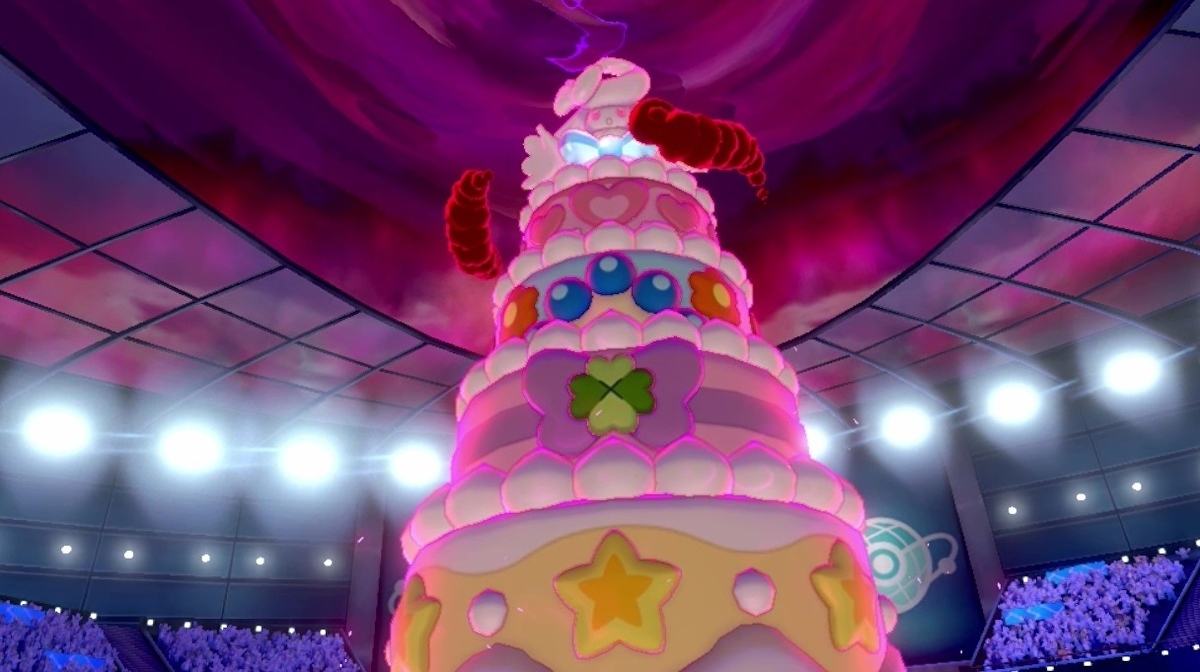
[caption id="attachment_1590" align="alignnone" width="1200"]alcremie gigantamax Alcremie Gigantamax form[/caption]
This article is written thanks to my dearest Patrons and special thanks to: Acelin, Alexandra Morgan, Laura Watson, MasterofCubes, Makkovar, Otakundead and Spencer Gill.

2 Kasım 2019 Cumartesi

Graphics

n late 2000s and in 2010s, video game graphics have matured tremendously. It has become a rare instance where a professionally developed (regardless of the budget) game is truly off putting to large groups of people. There are easy to access tools to make expressive, appealing visuals for your games; certain quality standards has become more and more accepted. And of course, graphics had always a lower priority compared to a captivating gameplay. When a game is popular on PC for years and years, there is a good chance it's partly due to how friendly the game is to older systems. The enormous triumph of Gameboy and Wii owes to their low graphical capabilites. People still cherish old games, despite, and sometimes because of their old-fashioned graphics. As the average hardware has reached a certaim threshold of power, the limitations to making a game visually presentable has been largely eroded, as a result, computer graphics have surpassed merely being tolerable. Today, they are quite alright, even in the most humble smartphones.
This is an overwhelmingly positive progress, but there is a concerning side effect. Graphics, and visuals as whole has lost some spark. Even game magazines, despite how hyped up they usually are, had lost some of their excitement on this issue over the years. Tech-driven hype, at least on non-VR, non-3D side, has lost steam; due to simply how we perceive visuals: There is an incredible difference in rendering an object with polygons vs 200 polygons, 300 polygons vs 1000 polygons... but 10000 polygons vs 20000 polygons? 30000 polygons? 50000? After a certain count it starts to give diminishing returns. However, I wouldn't say this is the only reason. Rather, I would argue that, in the process of standardization, the industry as a whole actively made visuals less interesting, ironically while trying to chase the glory of the early 2000s. But.. why? For this, let's discuss a game where visuals make me really excited:
Screenshot 2019-05-10 01.11.01
Ori the Blind Forest(2015) is a gorgeous game. A screenshot from any moment of the game is worthy of a physical frame on the wall. From color composition, careful management of lightning and shadows, great cohesion in character designs, background and user interface to the tiniest details in the pixels; the game is filled with awe and wonder, but with a kind that wants to feel the player welcome rather than being overwhelmed. Not only that, it brims with life: The dim lights on the lab,  Ori's own movements, how the game communicates the weather and the mood of the scene with the most subtle changes. One could say that the game is like being in an animated movie, but this is quite an understatement. Rather, it's as if player themselves is directing the animations, creating a whole alternate reality from drawings.
The feelings the visuals achieve to create do not entirely come from images alone. The controls, the sounds, the level design all play the same rhythm with the visuals. The game's difficulty for instance, is just right enough so that, a player can both linger enough in a level enough and savor the visuals for quite a while, but also make the player master the controls so that they can gradually learn to go blazing fast and dominate the landscape. When Ori takes a hit, its brief "ah!" and seconds of flashing red on its body both communicate the pain clearly without being disturbing, telegraph the invincibility frames and show how adorable Ori is at the same time. Many more examples can be given, but it can be seen that the graphics of the game are not just concened with presentation, they are baked in the language of the game. This is what makes the graphics in Ori the Blind Forest truly special, beyond just high fidelity and eye-candy effect.
Games often build a degree connection between their visuals and rest of the game as they develops naturally, but in some cases, it seems that the direction of visuals is actively towards abstracting this connection. Blizzard games certainly feel like this for example. Beginning with Warcraft 3(2002), all of their games started to share an art direction of easy-to-eyes, vibrant, expressive in-game graphics that don't lose too much quality on old system, coupled with highly detailed and photorealistic cutscenes with a slight cartoony streak which again, saves them from being dated. It is a very succesful style; very easy to make it distinct, appealing, and to maintain compared to pure photorealism, easily surpass most low-budgeted cartoony styles in polish, creates an easily distinguishable brand without needing to be unique, and adaptable to nearly anything. It is too successful for it's own good, it feels like a pretty package for the game, doesn't really add to it; negative or positively. Despite all of its glitter, the art direction in those games is lackluster when it comes to conveying emotion and character on its own, instead either relying on widely recognizable visual tropes or dazzling the players with excessive detail in cutscenes. Blizzard visuals always impress me for a short while, then it makes me feel there is something missing, a thing that a game like Bloodborne(2015), Celeste(2018) or even a game like Super Meat Boy(2010) has.
Isn't this at least a little vain? Seasoned programmers and artists working hundreds of hours with the most proffesional equipment, creating software for computers with the most powerful graphical processing unit and copious amount of memory space, so that we can see the our protagonist'sbody hair waving in the wind in our video game. A huge achievement for the research field, but in practice, all it achieves is to mildly impress people in trailers and have the same function as the graphics of Fortnite(2017), filling the basic duties of visuals, and carry little personality of their own. And among visual styles, photorealism perhaps has been misused the most this way.
uncharted beard a close up beard shot from Uncharted 4[/caption]First, let's establish what 'photorealism' is. It is not just when a game tries to be life-like. A game can be realistic, i.e. visual objects can feel like they have a tangible existence. However a gameWs art direction can be both realistic and stylized. For instance, Gone Home(2013) is rather down to earth with it is visuals, but has a cartoony feel that is not concerned too much with fidelity. Photorealism however, takes being "real" to its conclusion, its aim is to look like a as if recorded in a camera in a real life, a scene from the game looking like a photograph or a moment from a live-action movie. Looking realistic was a goal for video game graphics as old as graphics themselves, but photorealism only became feasible after technology has been developed to a certain point. Though there are earlier attempts of photorealism, notably with Full Motion Videos, it really became a thing in late 2000s when games slowly figured out how to look realistic in close detail without drenching themselves in brown. Then it evolved to its point of today, where we can savor the player character's body hair, every milimeter of dirt on their armor, the smallest detail on the guns with their full glory.
What does this exactly achieve? Well, it can put them ahead in competition, provides a good justification for sequels, looks cool in trailers, gives an incentive for updating game systems, serves as tech demos. What about the game itself? Despite how strict and demanding the style is,  it is often treated as default for a big action game, with actual questionable improvement of the game's experience. As much as I have criticized Blizzard graphics, they are at least indeed pleasant-looking and recognizable. Photorealism is not only at the mercy of the hardware but also it can only look nice and impressive as the scenes it is imitating from real life. A water stream, a garden, sun rising behind mountains can be made truly awesome, but muddy soliders or gray apartment blocks? What does being able to see every little detail provides us?  A game can have a gritty, broody or scary tone without photorealism. Telltale Walking Dead(2013-2019) games are serious and filled with gore as they can be without being over-the-top, yet they are cel-shaded, and this allows the games to depict visuals as detailed as they need while being cost effective and being able to have more control over the visual tone.
What does photorealism truly achieves is have precious moments from the game that truly looks like movies. A real oportunity for the PRESTIGE. Look at Last of Us(2013), Red Dead Redemption 2(2019) or Call of Duty: Modern Warfare(2019), how truly GREAT they are. I am not entirely ironic here, such games have truly impressive moments. However, those moments are fleeting; because in the end, a game not trying to look like a game is a desperate fight against itself, only in brief shots and cutscenes I get to have that "wow" effect. This creates a conflict between the gameplay and the visuals, and it's usually what this makes such graphics actually off-putting to me. The fact that gameplay systems did not have a drastic change over the years only excerbates this: One second there is a cutscene with faces with perfect motion capture, on the other there is an enemy who absorbs very real-looking bullets from a very real-looking gun like a sponge, barely even twitching its very real-looking body. Same guns, same covers, same skill trees, same stealth, same level design; all at least near two decades old.  Those gameplay systems were designed with the graphics of it's day. FPS pioneers were maze games, jumping became more pronounced in those games as 3D spaces expended vertically.  Then, as the graphic power increased, the gameplay become slower and in more cramped spaces to show show the objects in detail. But towards mid 2000s,  the gameplay systems which proved their merit just reused again and again while graphics evolved. That is perfectly fine in itself, but photorealism does not forgive such stagnation. Red Dead Redempton 2 goes extra mile to make everything "naturalistic" as possible, but because it conflicts with the fundemental game systems underneath, it can feel even more artificial at times.
All that being said, photorealism is just a style, and can be used well. Until Dawn(2015) is an apt example. The game goes out of its way to mimic horror movies. Its limited interaction helps to maintain the movie-like feel, photorealistic visuals feel meaningful and build the identity of the gaöe. The appeal of racing games often comes from the extreme detail on the cars coupled with precise physics engines, they exist to be car porns. However debatable its success is, L.A. Noire(2011) at least tries to use its motion capture technology in the gameplay. All of these examples prove that truly good visuals are the ones in harmony with other elements of the game.
Graphics matter. They posses an incredible power to shape our games., both for good and bad. And so much effort goes into creating them, they are major reason for crunches, bloating budgets, delays, two-digit gigabyte patches. Graphics don't have to be amazing, some games don't have any graphics at all, but if we are putting so much effort into them, They deserve better than to be "fine" with occasional "screenshot-worthy" moments. The technology we have can be much more than just more blood for the altar of marketing, it can provide us with truly special experiences, like Ori.
This article is written thanks to my dearest Patrons and special thanks to: Acelin, Alexandra Morgan, Laura Watson, MasterofCubes, Makkovar, Otakundead and Spencer Gill.